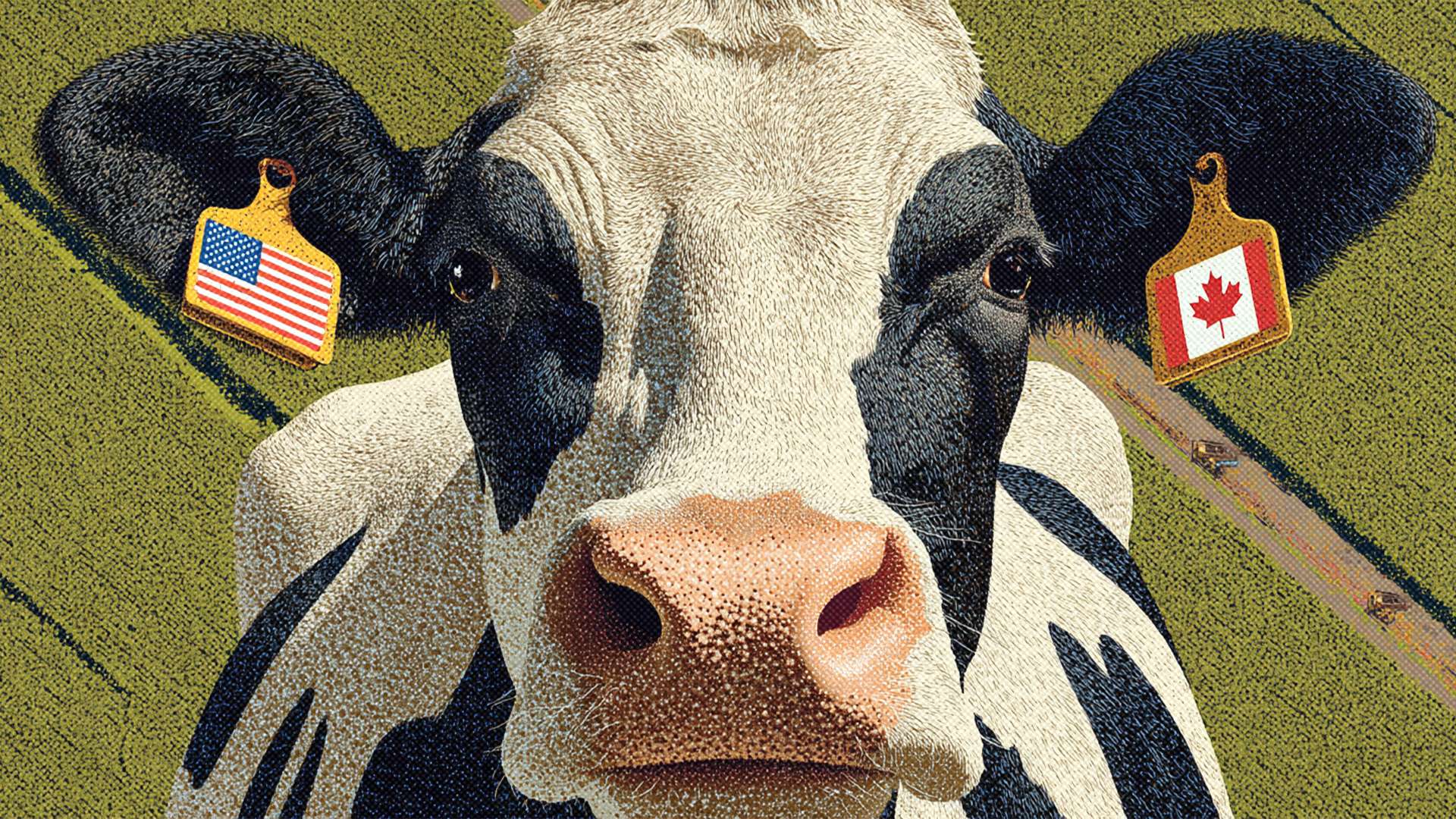
When President Donald Trump escalated his trade war with Canada earlier this year by slapping huge new tariffs on dairy products, the White House framed it as an attempt to strike back against Canadian protectionism.
asserted
House → escalate → protectionism
Those trade barriers, the White House said, would "make America wealthier and stronger, offsetting the burden and disadvantage" of the tariffs Canada was already charging against American dairy that crossed the border.
That approach assumes that Canadian dairy and American dairy are two completely separate products and that giving one an advantage means disadvantaging the other.
From Tom Gellert's vantage point, that doesn't make much sense.
asserted
that → say → sense
"Half of the cheese that we import from Canada to the U.S. is made with U.S. milk," says Gellert, the co-CEO of Gellert Global Group, a New Jersey–based food importer and distributor.
asserted
Gellert → import → Group
That milk comes from farms in New York, Wisconsin, the Dakotas, and elsewhere, and it makes its way to processing plants in Ontario to be turned into cheese and other products.
asserted
it → come → cheese
With American tariffs now at 50 percent—and with some dairy products banned outright by presidential decree—Gellert says that cross-border business model has become "unsustainable."
asserted
model → ban → decree
His business has already taken an estimated $40 million hit.
asserted
business → take → hit
But what about the claims that Canada is taking advantage of American dairy farmers by charging astronomically high tariffs? As Trump has put it: "So we want to sell milk into Canada, and they throw a 270 percent price increase on the milk.
uncertain
they → take → milk
That's wildly misleading, says Gellert.
asserted
Gellert → say → ?
Those tariffs don't kick in until after American imports hit a certain quota, which was set by the terms of the United States–Canada-Mexico Agreement (USMCA), the very trade deal that Trump negotiated during his first term.
asserted
Trump → kick → term
"I don't think it's an intellectually honest debate on the Canadian trade restrictions," says Gellert.
asserted
Gellert → think → restrictions
Total American dairy exports to Canada climbed by 67 percent between 2021 and 2024, thanks in large part to the USMCA.
asserted
exports → climb → USMCA
Trump's trade war has put that growth in jeopardy and crushed the cross-border supply chains that businesses such as Gellert Global Group—and its 700 employees—depend on.
asserted
businesses → put → Group
"We can't continue to pay 50 percent tariffs because we just can't afford to be giving money to the Treasury Department versus investing in the business," Gellert says.
asserted
Gellert → continue → business
Gellert has tried lobbying Congress and the Trump administration to ease the tariffs.
asserted
Gellert → try → tariffs
Now the company is turning to the courts.
asserted
company → turn → courts
Gellert Global Group is now the lead plaintiff in a lawsuit filed in the U.S. Court of International Trade that challenges the tariffs on Canadian imports.
asserted
that → file → imports
The company is working with the Liberty Justice Center, the same nonprofit law firm that successfully overturned Trump's "emergency" tariffs in a case decided by the Supreme Court earlier this year.
asserted
that → work → Court
The legal arguments for these trade barriers are as shaky as the economic arguments the administration has offered to justify them.
asserted
administration → offer → them
To impose those tariffs, Trump reached for Section 338 of the Tariff Act of 1930, which has not been used since the Great Depression.
asserted
which → impose → Depression
Some legal scholars, such as Philip Zelikow, a senior fellow at the Hoover Institution, argue that the law is defunct because it has been superseded by other legislation.
asserted
it → argue → legislation
Others argue that Trump's use of Section 338 is an unlawful expansion of executive power that violates the "major questions" doctrine—the same issue that helped sink Trump's earlier tariffs at the Supreme Court.
asserted
that → argue → Court
In the lawsuit, the Liberty Justice Center and Gellert Global Group outline five reasons why the tariffs should be struck down.
asserted
tariffs → outline → reasons
Even if the law hasn't been superseded by other provisions, the Trump administration has failed to properly follow it, their suit argues.
asserted
suit → supersede → it
For businesses like Gellerts, the completely unnecessary trade war between the U.S. and Canada has been a major disruption that offers nothing in return.
asserted
that → offer → return
Making Canadian cheese with American milk is proof that free trade works when the politicians get out of the way.
asserted
politicians → make → way
"We just want cooler heads to prevail in these trade negotiations," say Gellert.
asserted
Gellert → want → negotiations
"And, you know, we like to see the government operate in ways that are consistent with the law."
asserted
that → know → law
 The Aporia