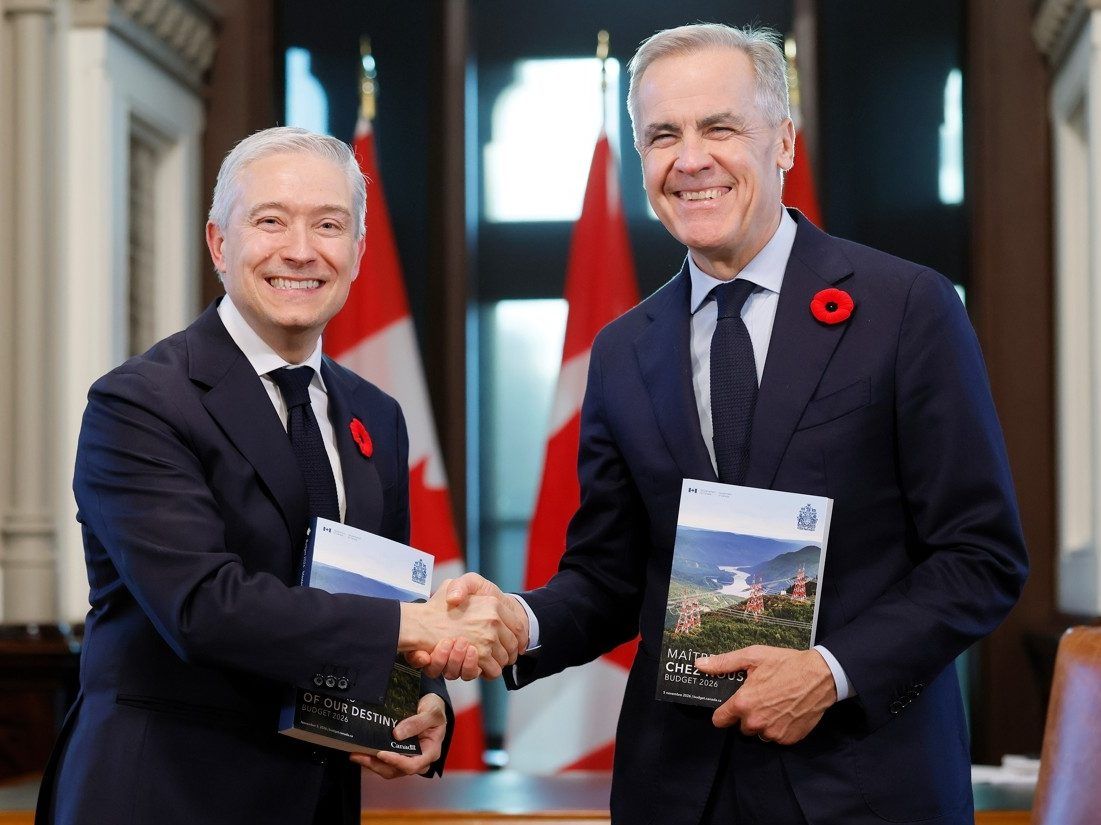
Photo via CBC News

Carney's bet on economic growth — and the risks that come with it

Read the original at CBC News ↗
Cite

Armstrong, P. (2025, November 9). Carney's bet on economic growth — and the risks that come with it. CBC News. https://www.cbc.ca/news/business/armstrong-canada-budget-2026-economy-risks-9.7411557?cmp=rss

Dated from the outlet's own feed. Check the original for its byline.

CBC News · collected 2026-11-06 · by Peter Armstrong

Quick Summary

Mark Carney, Canada’s Finance Minister, is implementing a massive public investment plan aimed at transforming the Canadian economy despite global economic uncertainties like trade wars and geopolitical shifts. By 2030-31, annual public debt charges are projected to reach $85.5 billion. The government hopes these investments will boost productivity and create jobs, but there’s concern over whether the economy could shift unfavorably before projects materialize, leaving Canada with heavy debt without tangible benefits.
Written by AI on 2026-11-06, from this article's own text only (the story summary below draws on all the coverage).
See how they differ ↓

AI analysis

Story summary

The Canadian government under Prime Minister Mark Carney officially unveiled its 2026 federal budget on November 5, 2026, focusing on a plan to change the nation's growth model and reduce economic reliance on the United States. Finance Minister Francois-Philippe Champagne stated that the budget prioritizes building domestic commerce, diversifying trade, and increasing Canadian sovereignty in response to shifting global trade dynamics and a U.S. trade war involving President Donald Trump. To achieve these goals, the government is utilizing a federal balance sheet bolstered by high energy prices and corporate profits to fund a long-term investment agenda, including financial guarantees for AI infrastructure and tax cuts for small businesses. Despite these measures, the budget has resulted in increased deficits and debt, with critics like former deputy finance minister Kevin Lynch warning that the government has spent its revenue windfall on new programs rather than reducing the deficit. Furthermore, the budget includes immigration targets that have faced criticism from Conservative Party leader Pierre Poilievre, who suggested the measures are part of a plan to increase the population to 100 million. While the government argues these investments will deliver future economic gains, some reports highlight that interest payments on existing debt are rising and that the federal borrowing rate remains a significant concern for taxpayers.

Written for “Canada's Budget 2026” on 2026-11-20, grounded in this article and the 55 other(s) covering the same event.

How they differ

9 outlets covered “Canada's Budget 2026”.

What each outlet says

One AI summary per outlet of its latest article on this story, written from that article alone and checked against it. Open the article for the outlet's own words.

CBCThis outlet6 Nov

Mark Carney, Canada’s Finance Minister, is implementing a massive public investment plan aimed at transforming the Canadian economy despite global economic uncertainties like trade wars and geopolitical shifts. By 2030-31, annual public debt charges are projected to reach $85.5 billion. The government hopes these investments will boost productivity and create jobs, but there’s concern over whether the economy could…

Carney's bet on economic growth — and the risks that come with it (this article)11 articles from CBC on this story
Toronto Star6 Nov

The federal budget for 2026 in Canada did not introduce any new measures to address student affordability issues or funding shortfalls in post-secondary education. Despite recognizing the importance of universities and colleges as key contributors to economic growth, the budget failed to provide additional support for students facing financial hardships or academic staff experiencing program cuts and job losses…

Federal budget 2026 silent on student affordability and public funding shortfall in post-secondary education →14 articles from Toronto Star on this story
Global News6 Nov

Budget 2026 proposes several tax changes aimed at reducing the administrative burden on Canadians. Key among these is changing the tax filing deadline from April 30 to May 15 for all taxpayers and self-employed individuals, eliminating the previous June 15 deadline for self-employed workers. This change aims to simplify tax filings and could save Canadians $230 million in interest and penalty payments over five…

These are all the key tax changes and credits impacting you from the budget →12 articles from Global News on this story
The Globe and Mail9 Nov

Prime Minister Mark Carney’s federal budget proposes a $30-billion plan to end homelessness in Canada by 2036. The initiative includes funding for 25,000 supportive and transitional homes, rental assistance, and health facilities addressing social needs. Housing experts welcome the pledge but emphasize the need for additional details and provincial cooperation to ensure success.

Housing experts welcome Ottawa’s plan to eradicate homelessness, but call for more details, funding →7 articles from The Globe and Mail on this story
The Hub9 Nov

The Canadian federal government has announced that it has reduced its workforce to meet the target of 330,000 employees by March 2029, well ahead of schedule. This reduction includes significant cuts in major departments such as the Canada Revenue Agency and Immigration, Refugees and Citizenship Canada, with reductions ranging from 15% to almost 32%. However, despite these cuts, federal employment is still 29%…

Is Canada’s runaway big-government bureaucracy finally under control? →5 articles from The Hub on this story
Toronto Sun12 Nov

This editorial criticizes Prime Minister Mark Carney’s government for misclassifying hundreds of billions of dollars in borrowing to finance government programs as investments rather than liabilities, thus obscuring the true extent of federal debt. Parliamentary Budget Officer Annette Ryan warns that federal borrowing is growing at more than double the rate of deficits, reaching $732.9 billion over the next five…

EDITORIAL: Beware Carney’s borrowing bomb →4 articles from Toronto Sun on this story
Show 3 more outlets
The Straits Times5 Nov

Canadian Prime Minister Mark Carney’s government presented its second budget on November 5 aimed at reducing reliance on the United States. Finance Minister Francois-Philippe Champagne emphasized diversifying trade and boosting domestic commerce within Canada as key priorities. The budget includes funding for national projects such as infrastructure for energy production and critical mineral mining, while also…

Canada unveils budget to curb reliance on US →
South China Morning Post6 Nov

Canada has unveiled a new budget titled “Masters of our Destiny,” which emphasizes economic independence from the United States. The plan acknowledges the ongoing shift away from traditional reliance on the U.S., noting it will take time but is underway. Presented two days after President Trump’s midterm election losses, the budget outlines Canada's intention to reduce its dependence on the U.S. market despite…

Canada budget charts ‘economic independence’ in decisive shift from US →
The Blaze9 Nov

Prime Minister Mark Carney’s Liberal government announced plans to increase immigration to Canada, aiming to grant permanent residency to approximately 380,000 migrants and admit another 370,000 temporary residents each year from 2027 to 2029. This includes additional one-time measures that could boost the number of permanent residents in 2027 to about 660,000. Conservative Party leader Pierre Poilievre and other…

'This is insane': Mark Carney slammed for overloading Canada with immigrants →

Where they agree and split

Framing

How the first headlines put it

Attributed to a source2
Stated as fact1
The headlines (3)

Budget 2026 is about ‘us,’ not the U.S. trade war, finance minister says Global News · attributed to a source

Federal budget is about 'changing Canada's growth model,' finance minister says Toronto Star · attributed to a source

Canada's next budget to be unveiled this week amid U.S. trade war, economic uncertainty CBC · stated as fact

Words to watch (1)

'This is insane': Mark Carney slammed for overloading Canada with immigrants The Blaze

The full story: what happened, how it changed, and all 56 articles →

Compared with similar articles

This article reads leans left and hedges 3% of its claims. Each row says how that neighbour differs.
The Globe and Mail
Leans left Hedges 6 of 35 claims Outlet record 51/100
The Hub
Hedges 5 of 39 claims
“The articles discuss different aspects of Carney's economic and defense strategies but do not describe the same specific incident or occurrence.”
Toronto Star
Leans right further right than this Hedges 0 of 2 claims Outlet record 64/100
“The articles discuss different aspects of Carney's leadership and economic policies without focusing on the same specific incident or meeting.”
The Globe and Mail
Hedges 0 of 2 claims Outlet record 51/100
“While both articles discuss Mark Carney's economic policies and budget plans, they describe different aspects of the same broader topic rather than the same specific incident or moment.”
Toronto Sun
Hedges 0 of 27 claims Outlet record 96/100
CBC News
Hedges 4 of 43 claims Outlet record 72/100
“The articles discuss different aspects of Canada's federal budget and economic strategies, but do not describe the same specific incident or happening.”
CBC News
Hedges 7 of 46 claims Outlet record 72/100
“The articles discuss different aspects of Mark Carney's economic and climate policies without describing the same specific incident.”
The Globe and Mail
Hedges 0 of 2 claims Outlet record 51/100
“The articles discuss different topics related to Canada's economy but do not describe the same specific incident or occurrence.”
Global News
Leans left Hedges 0 of 34 claims Outlet record 63/100

Story

Canada's Budget 2026
Economy/Business · 56 article(s) covering the same event. Compare every outlet's account →
How this article was measured signals, leaning charts, publisher record, byline, topics and claims

Signals How these are calculated →

Claims extracted
32
sentences that state something as happening or true
Uncertain
3%
1 of 32 hedged ("reportedly", "may", "according to")
Leaning
Leans left
of the writing, not the subject · beta estimate
Publisher signals
72/100
CBC News's corrections and hedging, across everything collected from it. Not a measure of accuracy.
Outlets on this story
56
Economy/Business
Same framing elsewhere
1
articles that frame the event the way this one does
Analyzed 2026-11-06 · how these are computed

How this is being covered How these are calculated →

Article leaning vs. publisher reliability
Source leaning vs. consistency

Publisher

CBC News · 2377 article(s) · 6 correction(s) detected
Running correction rate · 6 correction(s)

Who wrote this

Peter Armstrong
3 article(s) here · 1 carrying a prediction
If the investments don't pay off, Canada's debt load leaves it exposed Mark Carney is making a bet. He believes massive public investing now will position the Canadian economy to grow in spite of the trade war and the shifting winds of global geopolitics.
Economic frustration set to boil over in midterm elections Consumer sentiment hits all-time low as Americans head to the polls American voters are headed to the polls for the U.S. midterms this week.
But Canada would have to increase its China trade by more than 380 per cent to catch up to the amount of imports the U.S. still brings in every year.
Also by Peter Armstrong
Nothing else under this byline is closely related to this article, so these are simply their most recent.

Topics

Canada Canadian Ottawa the Institute of Fiscal Studies and Democracy the University of Ottawa

Subjects

Canada GPE · 8× Carney PERSON · 6× Khan PERSON · 3× CBC News ORG · 2× Canadian NORP · 2× Mark Carney PERSON · 1× Ottawa ORG · 1× Sahir Khan PERSON · 1× the Institute of Fiscal Studies and Democracy ORG · 1× the University of Ottawa ORG · 1×

Narrative

If the investments don't pay off, Canada's debt load leaves it exposed Mark Carney is making a bet. He believes massive public investing now will position the Canadian economy to grow in spite of the trade war and the shifting winds of global geopolitics.
framing: assertive · carried by 1 article(s) · first seen 2026-11-06
If the investments don't pay off, Canada's debt load leaves it exposed Mark Carney is making a bet. He believes massive public investing now will position the Canadian economy to grow in spite of the trade war and the shifting winds of global geopolitics.
2026-11-06 · CBC News
Carney's bet on economic growth — and the risks that come with it · assertive framing

Claims (32 extracted, 1 hedged)

Carney's bet on economic growth — and the risks that come with it asserted
that → come → it
If the investments don't pay off, Canada's debt load leaves it exposed Mark Carney is making a bet. He believes massive public investing now will position the Canadian economy to grow in spite of the trade war and the shifting winds of global geopolitics. asserted
economy → pay → geopolitics
By the 2030-31 fiscal year, the federal government will shoulder $85.5 billion in annual public debt charges. asserted
government → shoulder → charges
By then, Carney hopes the bet will have paid off and the economy will have undergone a transformation. asserted
economy → hop → transformation
"[Ottawa] is borrowing money for these major projects, hoping that it really jump-starts the economy," said Sahir Khan, executive vice-president of the Institute of Fiscal Studies and Democracy at the University of Ottawa. asserted
Khan → borrow → Ottawa
Khan says the risk is the economy shifts and macro trends change and leave Canada holding a pile of debt that never actually catalyzed growth or investment or created actual jobs. asserted
that → say → jobs
They're done when the projects actually get financed, people get hired and we see economic activity," said Khan. asserted
Khan → do → activity
Why many experts are backing Carney's plan Most experts, including Khan, believe the government's plan is a good idea. asserted
plan → back → Khan
They say Canada has not taken steps to boost investment and productivity in years and it shows. asserted
it → say → years
The economy was weak before the trade war began; in 2022, the Bank of Canada warned productivity was reaching emergency, "break glass" levels. asserted
productivity → begin → levels
Carney says his plan will address productivity, bring in investment for major projects that will create revenue and build jobs. asserted
that → say → jobs
He says the cost of that is clear, but manageable. asserted
cost → say → that
The key plank to that is the so-called productivity mega-deduction. asserted
plank → call → that
That alone is expected to encourage businesses to invest in their companies. asserted
That → expect → companies
It brings Canada's marginal effective tax rate to the lowest in any G7 country. asserted
It → bring → country
There's also a new Canada growth incentive, an exemption from capital gains that allows entrepreneurs to avoid taxes on up to $15 million in capital gains if those funds are reinvested in a Canadian business. asserted
funds → be → business
But those measures cost a lot of money. asserted
measures → cost → money
The productivity-mega deduction alone will cost some $36 billion over five years. asserted
deduction → cost → years
Carney told CBC News after the budget that his government is already taking measures to bring the deficit down. " asserted
government → tell → deficit
We've got spending under control, shifting to invest to be masters of our own destiny. asserted
We → get → destiny
Canada's moving forward is a fantastic day for the country," said Carney. asserted
Carney → move → country
But the risk isn't just that these bets don't turn into shovels in the ground or actual jobs. asserted
bets → turn → ground
Adam Chambers, Conservative shadow critic for innovation, science and industry, worries what happens if some other global event crashes into the economy while we have taken on so much debt to deal with the current crisis. " asserted
we → worry → crisis
There's no question the probability of there being an event is rising. asserted
probability → be → ?
Certainly the debt markets would suggest that there is some volatility happening," he said. asserted
he → suggest → ?
The federal government has touted what it calls Canada's "fiscal capacity." asserted
it → tout → what
Canada has not borrowed nearly as much as other advanced economies and, as a result, the borrowing costs here are lower than they are in many other jurisdictions. asserted
they → borrow → jurisdictions
But the list of unexpected events that have changed the economic landscape and made debt riskier is a long one. asserted
debt → change → landscape
But if the government is wrong, then the financial health of the country could deteriorate actually quite quickly," he told CBC News. uncertain
he → deteriorate → News
Chambers says those rising debt service payments should give everyone pause. asserted
payments → say → pause
By the end of the budget's projections, the deficit will be lower, the debt to GDP ratio will remain within the government's guardrails. asserted
ratio → remain → guardrails
But those debt service payments will be at $85.5 billion and sit as the second largest single expenditure in the budget. And all that a full two years after the end of Donald Trump's term as president. asserted
payments → sit → president
Give feedback · no sign-in needed

No sign-in needed for now. Your note is sent without a name, so it cannot be answered.

History Support