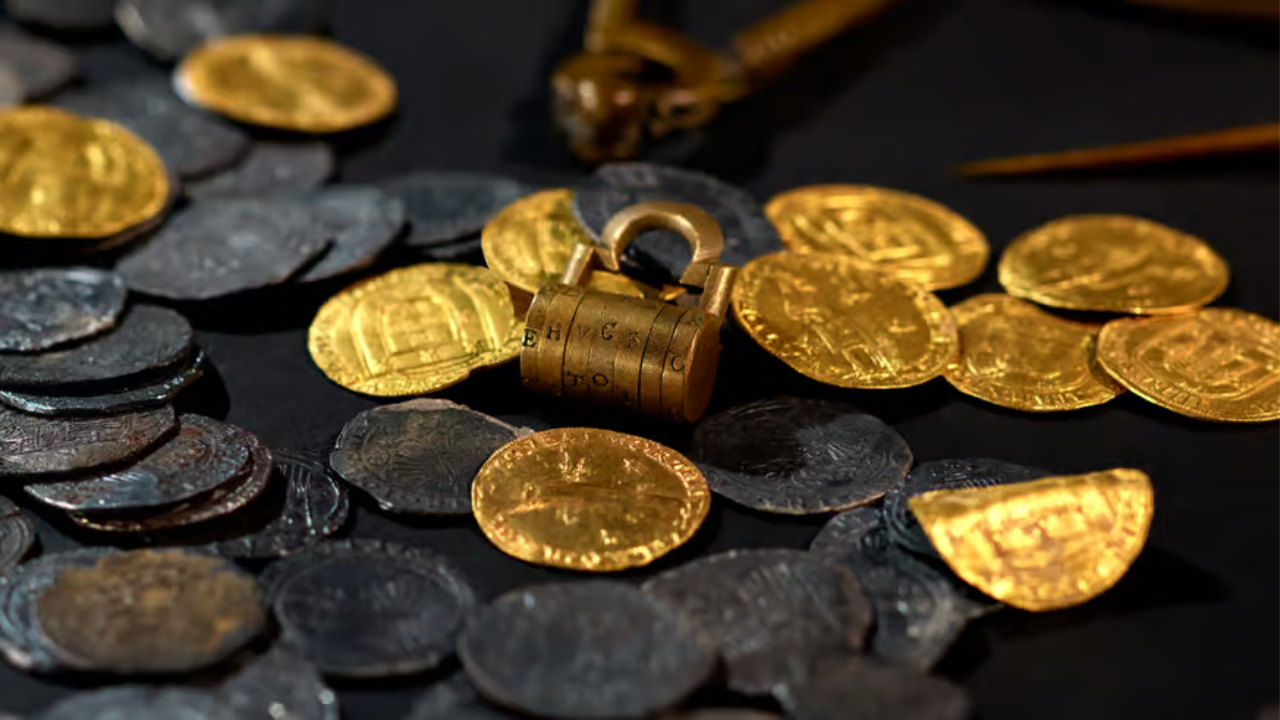
Photo via Times of India

CT scans cracked the code of a brass lock from a 1583 shipwreck off Wales, 443 years later, intact

Read the original at Times of India ↗
Cite

TOI World Desk. (2026, November 6). CT scans cracked the code of a brass lock from a 1583 shipwreck off Wales, 443 years later, intact. Times of India. https://timesofindia.indiatimes.com/world/uk/in-1583-a-ship-returning-from-spain-wrecked-off-wales-443-years-later-scientists-used-ct-scans-to-crack-the-four-letter-code-of-its-brass-combination-lock-without-damaging-the-centuries-old-mechanism/articleshow/135564473.cms

Dated from the outlet's own feed. Check the original for its byline.

Times of India · collected 2026-11-06 · by TOI World Desk

Quick Summary

Researchers used CT scanning technology to solve a four-century-old brass combination lock from a shipwreck off the Welsh coast that occurred in 1583. The lock, found on Margam Beach near Port Talbot and recovered by metal detectorist Peter Hughes over two decades, was opened using the code ANCE without damaging it. Cardiff University and Amgueddfa Cymru (Museum Wales) collaborated to reveal the internal mechanism of the lock with micro-CT scans, confirming its combination for the first time since its burial. The original purpose of the lock remains unknown, though researchers speculate that it may have secured a chest containing valuable items from the ship.
Written by AI on 2026-11-06, from this article's own text only (the story summary below draws on all the coverage).
See how they differ ↓

AI analysis

Story summary

Experts have cracked a four-letter code to open an ancient brass padlock from a shipwreck off the Welsh coast using modern scanning technology, solving a 400-year-old mystery. The lock was found by metal detectorist Peter Hughes in 1999 near Margam Beach in Port Talbot and is believed to have protected valuable items like Spanish silver coins or secured chests containing documents or textiles that did not survive. Researchers from Cardiff University and Amgueddfa Cymru (Museum Wales) used CT scanning to identify the combination as ANCE without damaging the lock, which was part of a treasure hoard from the shipwrecked Ann Francis, caught in a storm off the Welsh coast on December 28, 1583. The discovery provides context for understanding the cargo and artifacts from this historic wreck.

Written for “Code Cracked in Shipwreck Padlock” on 2026-11-22, grounded in this article and the 1 other(s) covering the same event.

How they differ

2 outlets covered “Code Cracked in Shipwreck Padlock”.

What each outlet says

One AI summary per outlet of its latest article on this story, written from that article alone and checked against it. Open the article for the outlet's own words.

Times of IndiaThis outlet6 Nov

Researchers used CT scanning technology to solve a four-century-old brass combination lock from a shipwreck off the Welsh coast that occurred in 1583. The lock, found on Margam Beach near Port Talbot and recovered by metal detectorist Peter Hughes over two decades, was opened using the code ANCE without damaging it. Cardiff University and Amgueddfa Cymru (Museum Wales) collaborated to reveal the internal mechanism…

CT scans cracked the code of a brass lock from a 1583 shipwreck off Wales, 443 years later, intact (this article)
BBC4 Nov

Experts used modern CT scanning technology to unlock a 400-year-old brass padlock discovered by metal detectorist Peter Hughes in Wales in 1999. The padlock is believed to be from the shipwreck of the Ann Francis, which sank off the Welsh coast in December 1583 while returning from Spain. The code "ANCE" was deciphered after years of attempts by Hughes and museum experts. Dr David Williams of Cardiff University…

Code cracked for shipwreck padlock solving 400-year-old mystery →

Compared with similar articles

This article reads unscored and hedges 17% of its claims. Each row says how that neighbour differs.
BBC News
Hedges 3 of 34 claims Outlet record 65/100

Story

Code Cracked in Shipwreck Padlock
Technology · 2 article(s) covering the same event. See how they differ ↑
How this article was measured signals, leaning charts, publisher record, byline, topics and claims

Signals How these are calculated →

Claims extracted
35
sentences that state something as happening or true
Uncertain
17%
6 of 35 hedged ("reportedly", "may", "according to")
Leaning
not political
takes no side on a contested political question
Publisher signals
58/100
Times of India's corrections and hedging, across everything collected from it. Not a measure of accuracy.
Outlets on this story
2
Technology
Same framing elsewhere
1
articles that frame the event the way this one does
Analyzed 2026-11-06 · how these are computed

How this is being covered How these are calculated →

Article leaning vs. publisher reliability
Source leaning vs. consistency

Publisher

Times of India · 5552 article(s) · 7 correction(s) detected
Running correction rate · 7 correction(s)

Who wrote this

TOI World Desk
1589 article(s) here · 1 carrying a prediction
She added that the rescue involved considerable risk because of the possibility that the vehicle could explode while the teenager remained trapped inside.
“I just hit the ball as I would normally that day, I knew it was a good shot because I had reached the green - but I didn't know how good,” she told the broadcaster.
What you write in a yearbook can follow you much further than you might imagine.
Sources told the New York Post that they believed the fire may have been deliberately set off remotely and alleged that the apartment had been wired to record visitors.
Court says insurer must defend bar owner The appeals court ruled that the insurer could not rely on its own investigation to avoid its duty to defend the business when the underlying complaint alleged negligence that potentially fell within the policy's coverage.
It found that the company was not an owner or beneficial title holder of the Phoenix property when Olsen recorded his 2015 deed and therefore could not pursue that particular claim.
It had been expected to fetch around £80,000, but the final price reached £150,000, The Independent reported.
The arrangement is an example of how conservation easements allow private landowners to retain their property while permanently limiting activities that could damage its environmental value.
may have expected an outside view, but some say they ended up staring at a blank cabin wall instead.
Seal Cove objected, arguing that the donation would reduce the endowment available to support its operations and therefore breach the agreements.
Wire or desk byline, not an individual reporter.
Also by TOI World Desk
Nothing else under this byline is closely related to this article, so these are simply their most recent.
All 1589 articles by TOI World Desk →

Topics

Amgueddfa Cymru Cardiff University Museum Wales Spain Wales

Subjects

Amgueddfa Cymru ORG · 4× Cardiff University ORG · 2× Spain GPE · 2× Wales ORG · 2× Welsh NORP · 2× David Williams PERSON · 1× Margam Beach GPE · 1× Museum Wales ORG · 1× Peter Hughes PERSON · 1× Port Talbot GPE · 1×

Narrative

Alastair Willis, senior curator for numismatics and the Welsh economy at Amgueddfa Cymru, said that Elizabethan combination locks were known in Britain, but this example was particularly interesting because of its condition and its connection to a shipwreck with a recorded date.
framing: assertive · carried by 1 article(s) · first seen 2026-11-06
Its rotating letter rings remained movable despite spending centuries beneath the sand, but nobody could open it.

Claims (35 extracted, 6 hedged)

A ship returning from Spain was caught in a violent storm and wrecked off the coast of Wales in 1583. asserted
ship → return → 1583
Among the objects recovered from the wreck was a brass combination lock that remained closed for more than four centuries. asserted
that → recover → centuries
Researchers have now solved its four-letter code without forcing it open, using advanced CT scanning technology to examine the delicate mechanism. asserted
Researchers → solve → mechanism
Cardiff University announced the discovery on November 4, 2026, following research conducted with Amgueddfa Cymru, also known as Museum Wales. asserted
University → announce → Wales
The researchers successfully identified the combination as ANCE and opened the lock without damaging it. asserted
researchers → identify → it
The discovery has helped solve a centuries-old puzzle, although researchers are still uncertain about what the lock originally protected and why its owner chose those four letters. asserted
owner → help → letters
A ship lost off the Welsh coast The ship, named Ann Francis, was returning from Spain when it encountered a severe storm on December 28, 1583. asserted
it → lose → December
Blown off course, it eventually wrecked on Margam Beach, near Port Talbot in south Wales. asserted
it → blow → Wales
Much of its cargo remained buried beneath the sand for centuries. asserted
Much → remain → centuries
Metal detectorist Peter Hughes discovered most of the recovered treasure over 21 years, between 1996 and 2017. asserted
Hughes → discover → 1996
Storms and dredging gradually removed layers of sand at Margam Beach, exposing coins and other objects from the sixteenth-century vessel. asserted
Storms → remove → vessel
The brass combination lock was among the recovered items. asserted
lock → recover → items
Its rotating letter rings remained movable despite spending centuries beneath the sand, but nobody could open it. uncertain
nobody → rotate → it
The artefact was subsequently acquired by Amgueddfa Cymru and became the subject of further investigation. asserted
artefact → acquire → investigation
CT scans revealed the hidden combination Instead of attempting to force the lock open and risk damaging it, researchers from Amgueddfa Cymru collaborated with specialists at Cardiff University to examine its internal structure. asserted
researchers → reveal → structure
Dr David Williams, a research associate at Cardiff University's School of Engineering, used micro-CT scanning to produce detailed three-dimensional images of the lock's internal mechanism. asserted
Williams → use → mechanism
The technology allowed researchers to examine components that could not be seen from the outside. uncertain
that → allow → outside
By studying the positions of the internal notches and their alignment with the letters on the rotating rings, the team identified the four-letter combination as ANCE. asserted
team → study → ANCE
Researchers then tested the combination and successfully opened the lock, confirming that their findings were correct. asserted
findings → test → lock
The process allowed them to unlock the centuries-old object without physically dismantling or damaging its mechanism. asserted
them → allow → mechanism
Williams explained that the scanning facility was normally used to examine bones and other biological structures, making the investigation of a historic combination lock an unusual application of the technology. asserted
investigation → explain → technology
What could the lock have protected? uncertain
lock → protect → What
Although researchers have discovered how to open the lock, its original purpose remains a mystery. asserted
purpose → discover → lock
They believe it may have secured a small chest containing valuable belongings. uncertain
it → believe → belongings
The lock was discovered near Spanish silver coins and two coin weights recovered from the shipwreck. asserted
lock → discover → shipwreck
This has led researchers to consider whether it might have protected valuable objects or a collection of personal belongings. uncertain
it → lead → belongings
However, the contents of the possible chest have not been established. asserted
contents → establish → chest
Researchers believe it could have contained items such as documents or textiles that have not survived the centuries since the wreck. uncertain
that → believe → wreck
Alastair Willis, senior curator for numismatics and the Welsh economy at Amgueddfa Cymru, said that Elizabethan combination locks were known in Britain, but this example was particularly interesting because of its condition and its connection to a shipwreck with a recorded date. asserted
example → say → date
Researchers are also interested in understanding whether the letters ANCE had a personal or symbolic significance for the person who originally set the combination. asserted
who → understand → combination
Historic treasure goes on display The brass lock is among the Ann Francis shipwreck artefacts featured in the Tides of Treasure exhibition at the National Waterfront Museum in Swansea. asserted
lock → go → Swansea
The collection also includes rare gold coins from the reign of Ferdinand and Isabella of Spain and a boatswain's whistle recovered from the wreck. asserted
collection → include → wreck
The treasure was acquired for Wales's national collection with support from the Welsh Government. asserted
treasure → acquire → Government
The discovery has revealed how a centuries-old combination lock worked while preserving its original mechanism. asserted
lock → reveal → mechanism
Although the meaning of its four-letter code and the identity of the person who set it remain unknown, modern scanning technology has helped researchers unlock another part of the story of the Ann Francis, more than 400 years after the ship sank. asserted
ship → set → Francis
Give feedback · no sign-in needed

No sign-in needed for now. Your note is sent without a name, so it cannot be answered.

History Support