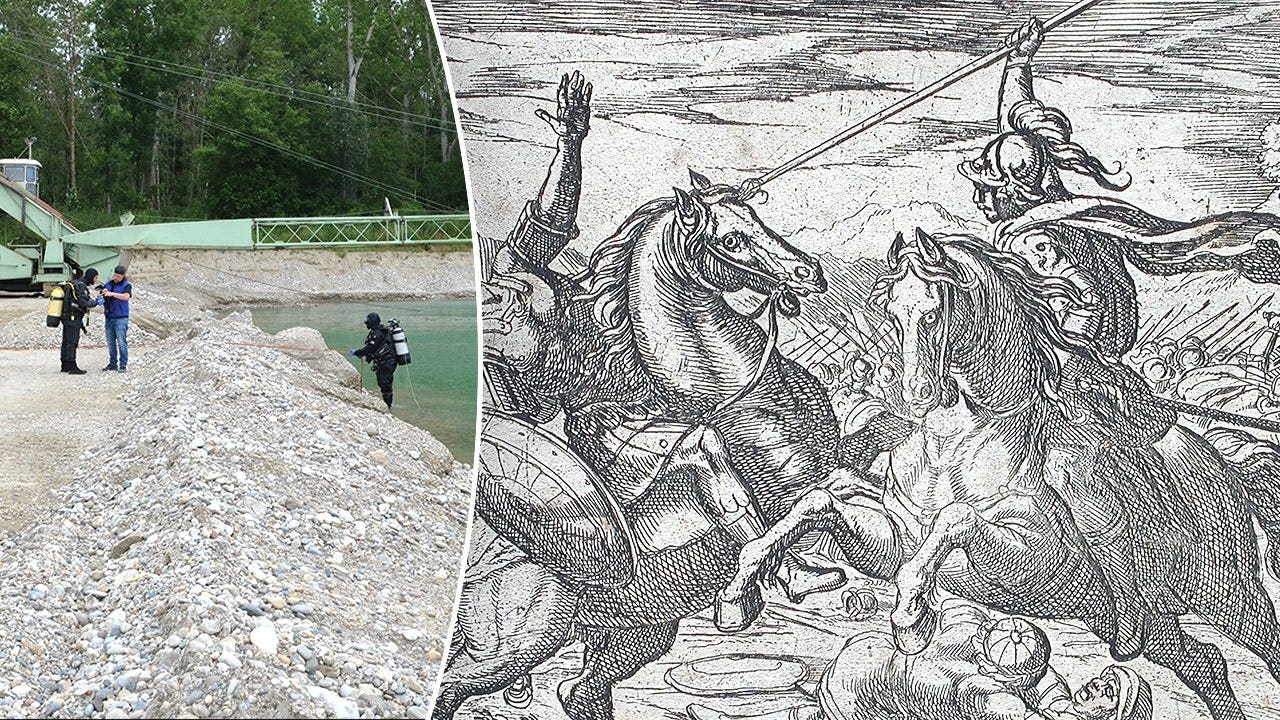
Photo via New York Post

Enough iron to forge 500 swords discovered in river as ancient ‘rusty treasure’ emerges

Read the original at New York Post ↗
Cite

Fox News. (2026, November 1). Enough iron to forge 500 swords discovered in river as ancient ‘rusty treasure’ emerges. New York Post. https://nypost.com/2026/10/31/world-news/ancient-rusty-treasure-emerges-from-river-with-enough-iron-to-forge-500-swords/

Dated from the outlet's own feed. Check the original for its byline.

New York Post · collected 2026-11-01 · by Fox News

Quick Summary

Archaeologists in Austria have discovered over 500 iron bars dating back to around the third or second century B.C., making it Europe’s largest known collection from the Iron Age. The find, weighing more than one metric ton and potentially enough to forge about 500 swords, was recovered during gravel extraction work on the Danube River in Deinham, Austria. Researchers believe these iron bars may have been lost in a shipwreck while being transported along the river for trade purposes.
Written by AI on 2026-11-01, from this article's own text only (the story summary below draws on all the coverage).
See how they differ ↓

AI analysis

Story summary

Archaeologists have discovered Europe's largest known collection of Iron Age iron bars in Austria, with at least 500 bars recovered from the Danube River. The find, dating back over 2,000 years, includes more than a metric ton of iron and could have been used to forge approximately 500 swords. Found during gravel extraction work in Deinham, Austria, in 2019, the "rusty treasure" was reported to the Monuments Authority by workers who could have sold it as scrap metal but chose not to. The collection is significant because iron production and trade were expanding across Europe at that time, making this cargo extremely valuable. Researchers from the University of Innsbruck published their findings in the journal *Antiquity*.

Written for “Ancient Rusty Treasure Found” on 2026-11-22, grounded in this article and the 1 other(s) covering the same event.

How they differ

2 outlets covered “Ancient Rusty Treasure Found”.

What each outlet says

One AI summary per outlet of its latest article on this story, written from that article alone and checked against it. Open the article for the outlet's own words.

New York PostThis outlet1 Nov

Archaeologists in Austria have discovered over 500 iron bars dating back to around the third or second century B.C., making it Europe’s largest known collection from the Iron Age. The find, weighing more than one metric ton and potentially enough to forge about 500 swords, was recovered during gravel extraction work on the Danube River in Deinham, Austria. Researchers believe these iron bars may have been lost in a…

Enough iron to forge 500 swords discovered in river as ancient ‘rusty treasure’ emerges (this article)
Fox News31 Oct

Archaeologists in Austria discovered Europe's largest known collection of Iron Age iron bars near the Danube River. At least 500 iron bars weighing over a metric ton were found during gravel extraction work in Deinham, dating back to around the third or second century B.C. Researchers believe these iron bars could have been used to forge about 500 swords and suggest they may have been transported from Bavaria before…

Ancient 'rusty treasure' emerges from river with enough iron to forge 500 swords →

Compared with similar articles

This article reads unscored and hedges 12% of its claims. Each row says how that neighbour differs.
Fox News
Hedges 3 of 23 claims Outlet record 66/100

Story

Ancient Rusty Treasure Found
Science · 2 article(s) covering the same event. See how they differ ↑
How this article was measured signals, leaning charts, publisher record, byline, topics and claims

Signals How these are calculated →

Claims extracted
25
sentences that state something as happening or true
Uncertain
12%
3 of 25 hedged ("reportedly", "may", "according to")
Leaning
not political
takes no side on a contested political question
Publisher signals
66/100
New York Post's corrections and hedging, across everything collected from it. Not a measure of accuracy.
Outlets on this story
2
Science
Same framing elsewhere
1
articles that frame the event the way this one does
Analyzed 2026-11-01 · how these are computed

How this is being covered How these are calculated →

Article leaning vs. publisher reliability
Source leaning vs. consistency

Publisher

New York Post · 21991 article(s) · 42 correction(s) detected
Running correction rate · 42 correction(s)

Who wrote this

Fox News
544 article(s) here · 1 carrying a prediction
However, Zacharia appeared to not harbor any ill-will toward her former boss, telling The Free Press that she does not intend to spill any secrets about the White House because “there’s nothing terrible to write.”
Advertisement Toronto publication Now Toronto asked residents to weigh in on the “prince treatment” trend, highlighting a video by Toronto-based TikTok creator Shaurya Manocha arguing that men deserve to be spoiled. “I would want my daughter to have somebody treat her like the princess that she is …
And I thought it would have been maybe one of the easier ones to get ended.
Advertisement “And, by the way, John Cornyn would have lost.
GTA 6 craze could ruin relationships from excessive gaming, expert says
Maher’s comments were noticed by Democratic strategist Kaivan Shroff, who suggested to Fox News Digital that the comedian could be acting a bit hypocritical in his final monologue of the season.
This will take you directly to the BetMGM app or website and automatically apply the promo code.
Williams-Brice is one of the loudest stadiums in the conference after dark, and South Carolina has already beaten Tennessee and won at Oklahoma this season.
Georgia’s offense is scoring at will, and South Carolina has the playmakers to contribute its share.
The Bulldogs visit South Carolina at 7:30 p.m. ET under the lights at Williams-Brice Stadium.
Wire or desk byline, not an individual reporter.
Also by Fox News
Nothing else under this byline is closely related to this article, so these are simply their most recent.
All 544 articles by Fox News →

Topics

Austria Fox News Fox News Digital the Monuments Authority the University of Innsbruck

Subjects

Trebsche PERSON · 5× Austria GPE · 3× Fox News Digital ORG · 2× the Monuments Authority ORG · 2× Andrea Margolis PERSON · 1× Deinham GPE · 1× Fox News ORG · 1× Marion Berranger PERSON · 1× Peter Trebsche PERSON · 1× the University of Innsbruck ORG · 1×

Narrative

“Fortunately, the gravel workers [who found the iron bars] reported this find to the Monuments Authority and did not sell them to a scrap dealer,” Peter Trebsche, a professor at the University of Innsbruck in Austria, told Fox News Digital.
framing: assertive · carried by 1 article(s) · first seen 2026-11-01
The “rusty treasure,” as researchers called it in a press release, would have been extremely valuable during the Iron Age, when iron production and trade were expanding across Europe.

Claims (25 extracted, 3 hedged)

Enough iron to forge 500 swords discovered in river as ancient ‘rusty treasure’ emerges asserted
treasure → forge → river
Archaeologists have identified Europe’s largest known collection of Iron Age iron bars in Austria — raising the possibility that the valuable cargo was lost in a shipwreck on the Danube River more than 2,000 years ago. asserted
cargo → identify → River
Workers recovered at least 500 bars, making the collection the largest known Iron Age find of its kind in Europe. asserted
collection → recover → Europe
The “rusty treasure,” as researchers called it in a press release, would have been extremely valuable during the Iron Age, when iron production and trade were expanding across Europe. asserted
production → call → Europe
“Fortunately, the gravel workers [who found the iron bars] reported this find to the Monuments Authority and did not sell them to a scrap dealer,” Peter Trebsche, a professor at the University of Innsbruck in Austria, told Fox News Digital. asserted
Trebsche → find → Digital
The iron bars — which weigh more than a metric ton in total — could have been used to forge roughly 500 swords weighing between 3.3 and 4.4 pounds each, according to the researchers. uncertain
which → weigh → researchers
The research was published earlier this fall by archaeologist Trebsche as well as archaeologist Marion Berranger in the journal Antiquity. asserted
research → publish → journal
The iron bars were originally discovered in 2019 during gravel extraction work in Deinham, Austria. asserted
bars → discover → Deinham
Researchers used radiocarbon dating to determine the age of the iron bars, which likely date to the third or second century B.C. While its intended destination remains unknown, researchers believe the iron may have been forged in Bavaria, Germany, before being transported along the Danube River. uncertain
iron → use → River
The discovery sheds new light on the scale of ancient iron production, which has been difficult to measure because iron objects are often overlooked or difficult to date the researchers said. asserted
researchers → shed → date
“Fortunately, the gravel workers reported this find to the Monuments Authority and did not sell them to a scrap dealer.” asserted
workers → report → dealer
“Therefore, the discovery of numerous double-pointed iron objects during gravel extraction along the River Danube provided a unique opportunity to investigate large-scale prehistoric iron production and trade,” the press release said. asserted
release → provide → production
In a statement, Trebsche called the discovery “nothing short of a minor miracle.” asserted
Trebsche → call → miracle
He added, “I am sincerely grateful to the finders that [the workers] decided to donate this extraordinary trove to a state museum collection.” asserted
workers → add → collection
Trebsche told Fox News Digital the iron bars were found during gravel extraction work in an old, silt-filled channel of the Danube River. asserted
bars → tell → River
He said a shipwreck is the most plausible explanation for how the bars ended up in the river, although no remains of a vessel were found. asserted
remains → say → vessel
“No parts of the ship were recovered, because this section of the Danube poses some dangers to navigation like stone balls and sand banks,” Trebsche noted. asserted
Trebsche → recover → balls
“In support of this interpretation is also the fact that none of the finds shows signs of intentional destruction, which would be indicative of a ritual offering during the Late Iron Age.” asserted
which → show → Age
He also said the 500-sword figure is only an estimate, as the iron could have been used to make tools or jewelry instead of weapons. uncertain
iron → say → weapons
“The amount of iron from Deinham is about ten times larger than the largest iron hoard finds of that period,” he said. asserted
he → say → period
Trebsche said the most surprising aspect of the discovery was the sheer quantity of iron being transported at once — and the fact that so much was available for a single trade transaction during the Late Iron Age. asserted
much → say → Age
“This finding demonstrates the increased capacities of iron production that were reached in the 3rd/2nd century BC in the Danube region,” he said. asserted
he → demonstrate → region
A number of other Iron Age discoveries have been announced across Europe over the past year. asserted
number → announce → year
Earlier this year, archaeologists uncovered a 2,000-year-old temple in Denmark at a major Iron Age settlement that once served as a regional center of power and wealth. asserted
that → uncover → power
At around the same time, researchers announced the discovery of rare four-wheeled wagon remains among 950 Iron Age metal objects unearthed in northern England, marking the first potential evidence of such vehicles in Britain. asserted
researchers → announce → Britain
Give feedback · no sign-in needed

No sign-in needed for now. Your note is sent without a name, so it cannot be answered.

History Support