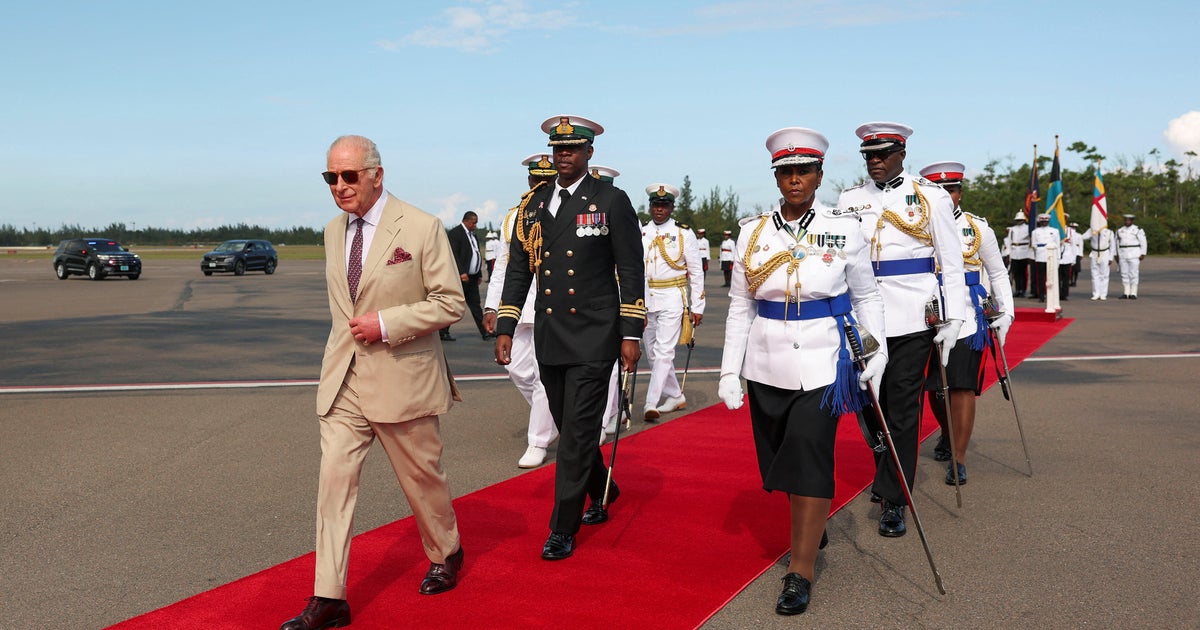
Photo via Evening Standard

Charles visits execution site of 1823 uprising against slavery

Read the original at Evening Standard ↗
Cite

Jones, T. (2026, October 30). Charles visits execution site of 1823 uprising against slavery. Evening Standard. https://www.standard.co.uk/news/uk/charles-the-king-king-commonwealth-b1303014.html

Dated from the outlet's own feed. Check the original for its byline.

Evening Standard · collected 2026-10-30 · by Tony Jones

Quick Summary

During his nine-day tour of the Caribbean, King Charles visited a park in Guyana where he acknowledged the history of slavery and resistance. Joined by Guyana’s culture minister Steven Jacobs, Charles saw a plaque commemorating those executed after the 1823 uprising against slavery led by Jack Gladstone. The visit comes as Caribbean nations call for Britain to apologize for its role in the slave trade and provide reparations. Some activists, like MP Terrence Campbell, argue that an apology is necessary but insufficient without concrete steps towards reparations.
Written by AI on 2026-10-31, from this article's own text only (the story summary below draws on all the coverage).
See how they differ ↓

AI analysis

Story summary

On October 30, 2026, King Charles visited Independence Park in Georgetown, Guyana, to commemorate the Demerera Slave Rebellion of 1823. Accompanied by Guyana’s Culture Minister Steven Jacobs, Charles acknowledged the site where hundreds of enslaved people were killed and many executed during the uprising. The visit was part of his nine-day tour of Caribbean nations aimed at addressing the legacy of slavery. At the park, a plaque commemorating those who were condemned to death and hanged from gallows erected on site was shown to the King. Charles did not offer an apology or reparations for Britain's role in the slave trade, aligning with the UK government’s stance. The visit came amid calls from Caribbean nations for Britain to formally apologize and provide reparations for its historical involvement in slavery.

Written for “Charles Visits Slave Rebellion Site” on 2026-11-21, grounded in this article and the 2 other(s) covering the same event.

How they differ

2 outlets covered “Charles Visits Slave Rebellion Site”.

What each outlet says

One AI summary per outlet of its latest article on this story, written from that article alone and checked against it. Open the article for the outlet's own words.

Evening StandardThis outlet30 Oct

During his nine-day tour of the Caribbean, King Charles visited a park in Guyana where he acknowledged the history of slavery and resistance. Joined by Guyana’s culture minister Steven Jacobs, Charles saw a plaque commemorating those executed after the 1823 uprising against slavery led by Jack Gladstone. The visit comes as Caribbean nations call for Britain to apologize for its role in the slave trade and provide…

Charles visits execution site of 1823 uprising against slavery (this article)2 articles from Evening Standard on this story
BBC30 Oct

The King visited Independence Park in Georgetown, Guyana, to commemorate the Demerera Slave Rebellion of 1823. Accompanied by Guyana's Culture Minister Steven Jacobs, he reflected on the historical site where hundreds of slaves were killed or executed following the rebellion. The visit is part of the King’s tour focusing on acknowledging Britain’s colonial legacy and its impact on former colonies. At Independence…

King visits Guyanan slave rebellion site on Caribbean tour →

Compared with similar articles

This article reads leans left and hedges 0% of its claims. Each row says how that neighbour differs.
Evening Standard
Leans left Hedges 0 of 12 claims Outlet record 64/100
BBC News
Hedges 1 of 23 claims Outlet record 65/100
Evening Standard
Leans left Hedges 1 of 18 claims Outlet record 64/100
“The articles describe different parts of Charles's nine-day tour in the Caribbean, one involving a carnival parade and the other an acknowledgment of historical slavery at an execution site.”
Evening Standard
Hedges 0 of 10 claims Outlet record 64/100
“The articles describe different parts of Charles's tour in Guyana; Article A mentions his arrival, while Article B describes a specific visit to an execution site during the tour.”
BBC News
Hedges 0 of 13 claims Outlet record 65/100
“The articles describe different parts of King Charles's Caribbean tour: Article A focuses on his arrival in Guyana, while Article B describes a specific visit to an execution site related to the history of slavery during his stay in Guyana.”
Evening Standard
Hedges 0 of 13 claims Outlet record 64/100
“The articles describe different parts of Charles's tour; Article A covers his visit to a historical site in Guyana, while Article B discusses his arrival and speech in Antigua and Barbuda.”
Evening Standard
Leans left Hedges 0 of 19 claims Outlet record 64/100
“The articles describe different parts of King Charles's tour; Article A outlines his planned visit, while Article B reports on a specific stop during the actual tour where he visited an execution site.”
Daily Mail
Hedges 2 of 50 claims Outlet record 69/100
“The articles describe different parts of the same tour; Article A covers Charles's arrival, while Article B describes a later visit to an execution site related to slavery.”
CBS News
Hedges 3 of 29 claims Outlet record 66/100
“While both articles describe parts of King Charles's tour of the Caribbean and related discussions about colonial legacy, they report on different specific events at distinct times and locations.”
Evening Standard
Hedges 0 of 13 claims Outlet record 64/100
“The articles describe different parts of King Charles's tour, with Article A focusing on his visit to a park in Guyana acknowledging slavery history and Article B discussing his arrival in Antigua and the Prime Minister's stance on apologies.”

Story

Charles Visits Slave Rebellion Site
Politics · 3 article(s) covering the same event. See how they differ ↑
How this article was measured signals, leaning charts, publisher record, byline, topics and claims

Signals How these are calculated →

Claims extracted
26
sentences that state something as happening or true
Uncertain
0%
0 of 26 hedged ("reportedly", "may", "according to")
Leaning
Leans left
of the writing, not the subject · beta estimate
Publisher signals
64/100
Evening Standard's corrections and hedging, across everything collected from it. Not a measure of accuracy.
Outlets on this story
3
Politics
Same framing elsewhere
2
articles that frame the event the way this one does
Analyzed 2026-10-31 · how these are computed

How this is being covered How these are calculated →

Article leaning vs. publisher reliability
Source leaning vs. consistency

Publisher

Evening Standard · 11120 article(s) · 82 correction(s) detected
Running correction rate · 82 correction(s)

Who wrote this

Tony Jones
100 article(s) here · 1 carrying a prediction
William and Kate spent three days in Mumbai celebrating Anglo-Indian links, young people and William’s environmental awards – which fulfilled their belief royal tours should have “purpose, meaning and impact”.
The visit came on the final day of William and Kate’s three-day trip to India and followed the couple’s tour of a craft school where they block printed their own silk scarves, while the prince later met Hindi movie stars at a film production company.
The princess spoke of the “seismic change” Earthshot Prize winners will generate during the awards ceremony which featured Oscar winning Hollywood star Rami Malek, Indian cricket legend Sachin Tendulkar while Take That performed for the 5,000 strong audience.
Kate hails ‘seismic change’ generated by Earthshot Prize winners The Princess of Wales spoke of the “seismic change” Earthshot Prize winners will generate to improve lives as the environmental innovators were celebrated.
He said about William: “I hate to name drop but we have got to know each other over the years through this and through the Baftas.
The Prince and Princess of Wales will be among those making the short journey to the auditorium where 15 finalists will discover which five have each won £1 million to scale up their ideas to repair the planet.
The event launched the couple’s three-day visit to India to stage William’s Earthshot Prize and they took up bat and ball to celebrate the nation’s obsession with cricket alongside one of the game’s greatest batsmen.
He delivered his speech in Mumbai, which will host the awards ceremony on Tuesday, when £1 million in prize money will be presented to the winners of five categories to scale-up solutions to “repair” the planet.
Also by Tony Jones
Nothing else under this byline is closely related to this article, so these are simply their most recent.
All 100 articles by Tony Jones →

Topics

Bahamas Britain Caribbean Commonwealth Guyana

Subjects

Charles PERSON · 8× Guyana GPE · 6× Bahamas GPE · 2× British NORP · 2× Commonwealth ORG · 2× Quamina PERSON · 2× Antigua GPE · 1× Britain GPE · 1× Caribbean NORP · 1× Steven Jacobs PERSON · 1×

Narrative

Mr Campbell said Charles had “moral persuasion” adding: “If the King comes out a little more boldly in the United Kingdom and also at the Commonwealth Heads of Government Conference, I think that he can use moral persuasion to move the needle, the needle of the British government, the needle of the other colonial powers, on this important issue of reparations.”
framing: assertive · carried by 2 article(s) · first seen 2026-10-30
Charles began his nine-day trip on Tuesday by acknowledging the “great suffering of the past” in a speech at a youth rally in the Bahamas, and confirmed a Commonwealth leaders’ summit he will open in Antigua next week would discuss the legacy of slavery.
2026-10-30 · Evening Standard
Charles visits execution site of 1823 uprising against slavery · assertive framing
2026-10-31 · Evening Standard
Charles visits execution site of 1823 uprising against slavery · assertive framing

Claims (26 extracted, 0 hedged)

Caribbean nations have made renewed calls for Britain to apologise for its role in selling enslaved people for profit, and for reparations, in the run-up to the King’s tour of the Caribbean. asserted
Britain → make → Caribbean
Charles began his nine-day trip on Tuesday by acknowledging the “great suffering of the past” in a speech at a youth rally in the Bahamas, and confirmed a Commonwealth leaders’ summit he will open in Antigua next week would discuss the legacy of slavery. asserted
he → begin → slavery
At the park Charles was joined by Guyana’s culture minister Steven Jacobs, to acknowledge the country’s history of slavery and resistance. asserted
Charles → join → slavery
The King listened intently as Mr Jacobs talked at the entrance of the former parade ground and showed him a plaque commemorating those who were condemned to death and hanged from gallows erected on site. asserted
who → listen → site
The rising began in August 1823 on the plantation of Sir John Gladstone, father of the future prime minister William Gladstone, when Jack Gladstone, an enslaved man named after his owner, rang the plantation bell to signal the start of the rebellion. asserted
Gladstone → begin → rebellion
His father Quamina, a carpenter on the same estate and a deacon at the local chapel, had urged a peaceful strike but the uprising was crushed with brutal force and hundreds were killed. asserted
hundreds → urge → force
Quamina was hunted down and killed the following month and his body was displayed outside the plantation as a warning to others – he is now one of Guyana’s national heroes – while his son was sold and sent to St Lucia. asserted
son → hunt → Lucia
Guyana’s President Mohamed Irfaan Ali said ahead of the visit Charles has recognised slavery as the darkest days in human history – but moving to the apology is “the next step”. asserted
moving → say → apology
In 2023, Charles described how he was on a personal journey of discovery and was continuing to “deepen my own understanding of slavery’s enduring impact”, in a speech at the opening of a Commonwealth summit hosted by Rwanda. asserted
he → describe → Rwanda
Terrence Campbell, an MP from Guyana’s A Partnership for Unity Party, claimed he and a small group of activists were stopped from protesting about reparations in the area by police. asserted
he → claim → police
They moved on to stage their demonstration outside a building where Charles met indigenous leaders in the capital, and held placards which read “No apology will return what was stolen reparations now”. asserted
what → move → reparations
The King follows the guidance of his ministers and it is understood the Government has not advised him to offer an apology or reparations, in keeping with established policy. asserted
Government → follow → policy
Mr Campbell said Charles had “moral persuasion” adding: “If the King comes out a little more boldly in the United Kingdom and also at the Commonwealth Heads of Government Conference, I think that he can use moral persuasion to move the needle, the needle of the British government, the needle of the other colonial powers, on this important issue of reparations.” asserted
he → say → reparations
Charles spent two days in the Bahamas and was joined at a number of events by the country’s prime minister Philip Davis who was interviewed by Sky News and asked about the King making an apology for slavery. asserted
King → spend → slavery
The politician said: “Whether I like to see him apologise, again, that’s a personal decision on his part after advice. “ asserted
that → say → advice
At the end of the day, how a repair would look, once that is satisfactory, how it comes, I will be satisfied.” asserted
I → look → day
He added: “Well, for me, repair and reparation is not absolutely money, simply, money. asserted
repair → add → me
“Some people think, I think, acknowledgment, firstly…which has been the first step, which we have now recognised. asserted
we → think → which
“Acknowledgement, education, training, things of that nature.” During the second day of his state visit, Charles attended events highlighting the environment, British-Guyana business links and the nation’s culture, meeting indigenous leaders. asserted
Charles → attend → leaders
He told the Global Biodiversity Alliance conference “nature has the best solutions to everything today” and met businesses contributing to Guyana being the UK’s largest trading partner in the Commonwealth Caribbean. asserted
Guyana → tell → Caribbean
Charles visited the Umana Yana, a huge thatched building used as a meeting place for indigenous leaders from the National Tashaos Council. asserted
Charles → visit → Council
The King was presented with a necklace placed round his neck, shook a pair of maracas used for witchcraft and was given an archer’s bow and arrow. asserted
King → present → bow
Charles met Tashao (chief) Derrick John, who visited the King’s Gloucestershire home of Highgrove last year, a meeting that was shown in the King’s Harmony film. asserted
that → meet → film
He said: “He was very interested in the role indigenous people play in protecting our forests and the funding that is being transferred through forest carbon credit financing to the indigenous community and how that is transforming lives. asserted
that → say → lives
“With Guyana being a small country we are taking a bold step.” asserted
we → take → step
The King ended his state visit by learning about Kingston Seawall as he strolled along the landmark, one of Georgetown’s most historic spots and a vital component of Guyana’s coastal defence system. asserted
he → end → system
Give feedback · no sign-in needed

No sign-in needed for now. Your note is sent without a name, so it cannot be answered.

History Support