Photo via New York Post

Giant new dwarf planet discovered in our own solar system — hiding in plain sight

Read the original at New York Post ↗
Cite

Palladino, A. (2026, October 28). Giant new dwarf planet discovered in our own solar system — hiding in plain sight. New York Post. https://nypost.com/2026/10/28/science/giant-new-dwarf-planet-discovered-by-rubin-observatory/

Dated from the outlet's own feed. Check the original for its byline.

New York Post · collected 2026-10-28 · by Andrea Palladino

Quick Summary

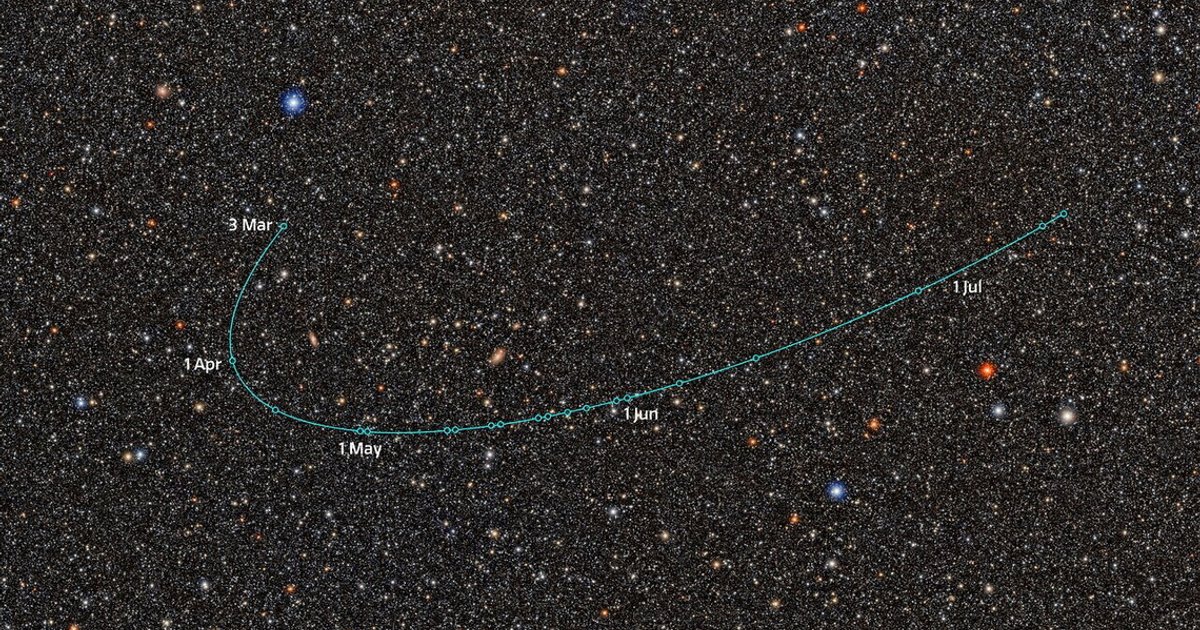
Scientists have discovered a new dwarf planet candidate named 2026 ED138 in the Kuiper Belt region beyond Neptune. The object was detected by the Vera C. Rubin Observatory in Chile, which began operations in June 2025 and first observed 2026 ED138 from March to July 2026. It has an orbit within Pluto’s distance range but was only recently identified due to its faintness and slow movement. The discovery highlights the observatory's capability to detect large, distant objects that previous surveys missed.
Written by AI on 2026-10-28, from this article's own text only (the story summary below draws on all the coverage).
See how they differ ↓

AI analysis

Story summary

Scientists using a Chile-based telescope have identified an icy object orbiting beyond Pluto that may be classified as a new dwarf planet. The candidate, named 2026 ED138, was first spotted by astrophysicist Matt Holman of the Center for Astrophysics, Harvard & Smithsonian on October 13, 2026. Estimated to have a diameter between roughly 600 and 1,500 kilometers and orbiting about 46 times farther from the sun than Earth, 2026 ED138 could potentially join five other recognized dwarf planets if confirmed.

The object was detected using the Vera C. Rubin Observatory in Chile, a joint initiative of the US National Science Foundation and Department of Energy. This discovery highlights the ongoing exploration and potential for new findings in our solar system's outer regions. Further observations are necessary to officially classify 2026 ED138 as a dwarf planet by the International Astronomical Union.

Written for “New Dwarf Planet Discovery” on 2026-11-22, grounded in this article and the 2 other(s) covering the same event.

How they differ

3 outlets covered “New Dwarf Planet Discovery”.

What each outlet says

One AI summary per outlet of its latest article on this story, written from that article alone and checked against it. Open the article for the outlet's own words.

New York PostThis outlet28 Oct

Scientists have discovered a new dwarf planet candidate named 2026 ED138 in the Kuiper Belt region beyond Neptune. The object was detected by the Vera C. Rubin Observatory in Chile, which began operations in June 2025 and first observed 2026 ED138 from March to July 2026. It has an orbit within Pluto’s distance range but was only recently identified due to its faintness and slow movement. The discovery highlights…

Giant new dwarf planet discovered in our own solar system — hiding in plain sight (this article)
The Straits Times28 Oct

Scientists using a Chile-based Vera C. Rubin Observatory have identified a new icy object orbiting beyond Pluto that could potentially become the seventh recognized dwarf planet in our solar system. Named 2026 ED138, this candidate has an estimated diameter between 370 and 930 miles and orbits at about 46 times Earth's distance from the sun. Further observations are needed to confirm its status as a dwarf planet…

Possible new dwarf planet identified orbiting beyond Pluto →
CBC28 Oct

Scientists using the Vera C. Rubin telescope in Chile have identified a new icy object beyond Pluto that could potentially be classified as a dwarf planet. Named 2026 ED138, this candidate has an estimated diameter between 600 and 1,500 kilometers and orbits about 46 times farther from the Sun than Earth does. Further observations are needed to confirm its status as a dwarf planet, which would make it one of six…

New Vera C. Rubin telescope spots possible new dwarf planet beyond Pluto →

Compared with similar articles

This article reads unscored and hedges 12% of its claims. Each row says how that neighbour differs.
CBC News
Hedges 1 of 21 claims Outlet record 60/100
The Straits Times
Hedges 1 of 17 claims Outlet record 64/100

Story

New Dwarf Planet Discovery
Science · 3 article(s) covering the same event. See how they differ ↑
How this article was measured signals, leaning charts, publisher record, byline, topics and claims

Signals How these are calculated →

Claims extracted
26
sentences that state something as happening or true
Uncertain
12%
3 of 26 hedged ("reportedly", "may", "according to")
Leaning
not political
takes no side on a contested political question
Publisher signals
66/100
New York Post's corrections and hedging, across everything collected from it. Not a measure of accuracy.
Outlets on this story
3
Science
Same framing elsewhere
1
articles that frame the event the way this one does
Analyzed 2026-10-28 · how these are computed

How this is being covered How these are calculated →

Article leaning vs. publisher reliability
Source leaning vs. consistency

Publisher

New York Post · 21991 article(s) · 42 correction(s) detected
Running correction rate · 42 correction(s)

Who wrote this

Andrea Palladino
41 article(s) here · 1 carrying a prediction
Advertisement Following a three-year wartime hiatus, the parade made a triumphant postwar return in 1945, capturing the nation’s spirit with a festive and patriotic celebration. A standout float from postwar years was the Harold the Clown balloon, which had four distinct outfits over four consecutive years — appearing as a classic clown, a baseball player, a police officer, and a firefighter. Harold the Baseball Player became a pop-culture icon and starred in the classic 1947 holiday film “Miracle on 34th Street.” National Broadcast Brings Parade Nationwide Advertisement That same landmark year, the parade reached an even broader audience with its national television broadcast debut on CBS in 1947, bringing the Manhattan streets directly into living rooms across the country. The 1950s marked a booming post-war parade era that even a national helium shortage couldn’t stop.
On Nov. 13, a rare nationwide Federal Aviation Administration (FAA) ground stop halted all U.S. departing flights for over four hours and triggered widespread travel chaos — but one North Dakota woman was willing to do – or spend – whatever it took to get to her destination.
On Dec. 4–5 from 5–10 p.m. PT, McDonald’s will host the Home Alone Challenge, an interactive pop-up in Los Angeles, CA.
The mix-and-match lineup will feature choices like the McDouble, McChicken, 6-piece chicken nuggets, and fries, priced between $3.50 and $4.00 depending on the market.
If 2026 ED138 is on the larger end of size estimates, it could rank alongside other dwarf planets — meaning its own gravity would be strong enough to pull it into a round shape.
Some purchases are destined to gather dust in the back of your closet, though you may not know it in the moment.
“Then they swipe again to see what’s next because there could always be someone better.”
Travelers heading to China could face years of detention under sweeping national security laws, according to an updated US State Department advisory.
Push-ups, for example, can provide quick relief by opening your nasal passages and reducing inflammation that may be affecting them.
Posey Meadows, a wedding hall in San Marcos, Texas, is under fire after refusing to refund a grieving bride whose fiancé tragically died just months before their big day — and then slapping her with a lawsuit. Diego Hernandez, 25, died suddenly in late April, seven months before he was set to walk down the aisle on Nov. 20.
Also by Andrea Palladino
Nothing else under this byline is closely related to this article, so these are simply their most recent.
All 41 articles by Andrea Palladino →

Topics

Chile the Dark Energy Camera the Harvard-Smithsonian Center the Minor Planet Center

Subjects

Holman PERSON · 2× Rubin PERSON · 2× Chile GPE · 1× Kevin Napier PERSON · 1× Matthew Holman PERSON · 1× the Harvard-Smithsonian Center ORG · 1× the Minor Planet Center ORG · 1×

Narrative

Astrophysicist Matthew Holman of the Harvard-Smithsonian Center spotted the object on Oct. 13, 2026, while analyzing Rubin observations using software developed with colleague Kevin Napier. Searching older data, the team found the object in images from the Dark Energy Camera dating back to February 2016.
framing: assertive · carried by 1 article(s) · first seen 2026-10-28
If 2026 ED138 is on the larger end of size estimates, it could rank alongside other dwarf planets — meaning its own gravity would be strong enough to pull it into a round shape.

Claims (26 extracted, 3 hedged)

This stellar new discovery needed some “space” before revealing itself. asserted
discovery → need → itself
Scientists have long struggled to map the region of space beyond Pluto, relying on scattered discoveries and indirect clues from other planets’ movements. asserted
Scientists → struggle → movements
Now, researchers have announced a new discovery from the Vera C. Rubin Observatory, high atop Cerro Pachón in Chile. asserted
researchers → announce → Chile
A large object in the Kuiper Belt — a distant region of icy and rocky bodies past Neptune — appears to be a new candidate dwarf planet. asserted
object → appear → Neptune
Named 2026 ED138, its entire orbit lies within Pluto’s distance range from the Sun, yet it was only just discovered. asserted
it → name → Sun
The Rubin Observatory features the largest digital camera ever built for astronomy, capable of capturing a patch of sky equal to 40 full moons in a single shot. asserted
Observatory → feature → shot
The telescope first saw light in June 2025, and by March 2026, the object entered its field of view. asserted
object → see → view
Since then, the team traced it through 30 detections across 20 nights of Rubin observations, dating from 4 March to 11 July 2026. asserted
team → trace → July
The light turned out to be one of the largest objects ever discovered past Neptune, potentially rivaling the size of other above-average dwarf planets, such as Makemake and Haumea. asserted
light → turn → Makemake
Astrophysicist Matthew Holman of the Harvard-Smithsonian Center spotted the object on Oct. 13, 2026, while analyzing Rubin observations using software developed with colleague Kevin Napier. Searching older data, the team found the object in images from the Dark Energy Camera dating back to February 2016. asserted
team → spot → February
The camera had also captured it in 2017, 2018, 2019, and 2023. asserted
camera → capture → 2017
Holman noted that objects like this are “very rare.” asserted
objects → note → this
Double-checking his work in “excited disbelief,” he made sure no errors had been made. asserted
errors → check → disbelief
The region beyond Neptune begins roughly 30 astronomical units (AU) from the Sun, and everything we know suggests far more remains hidden. uncertain
more → begin → Sun
The Kuiper Belt extends out to 55 AU, beyond which lies the theoretical Oort Cloud. asserted
Cloud → extend → which
Thousands of objects past Neptune hint at materials in even more distant reaches. asserted
Thousands → hint → reaches
Spotting them is extraordinarily difficult because they reflect very little sunlight and appear faint to telescopes. asserted
they → spot → telescopes
They are also extremely cold, giving off very little heat radiation (infrared light) for sensors to pick up. asserted
sensors → give → radiation
If 2026 ED138 is on the larger end of size estimates, it could rank alongside other dwarf planets — meaning its own gravity would be strong enough to pull it into a round shape. uncertain
gravity → rank → shape
The finding shows Rubin’s ability to repeatedly scan swaths of the sky and pick out faint, slow-moving bodies that earlier surveys missed — and reveal objects hiding in plain sight. asserted
surveys → show → sight
According to the Minor Planet Center, ED138 takes about 281 years to orbit the Sun, ranging from 36.86 Astronomical Units (AU) at its closest approach to 49.04 AU at its farthest. uncertain
ED138 → accord → farthest
Its orbit is also tilted by roughly 24.5 degrees relative to the rest of the solar system — a prime example of the orbital quirks that make these objects so hard to track. asserted
objects → tilt → quirks
Most planets sit on a relatively flat, disc-like plane called the ecliptic. asserted
planets → sit → plane
Because of this, astronomers focus the majority of their telescopes on this narrow band of the sky. asserted
astronomers → focus → sky
An object tilted by 24.5 degrees spends most of its time high above or far below this standard viewing zone, hiding where traditional surveys aren’t routinely looking. Researchers plan to decipher if the strange orbits are caused by a prodigal planet or a swarm of rocks. asserted
orbits → tilt → rocks
Either way, Holman says “Rubin will image the whole southern sky again and again, so any others hiding in the places earlier surveys skipped are now within reach.” asserted
surveys → say → reach
Give feedback · no sign-in needed

No sign-in needed for now. Your note is sent without a name, so it cannot be answered.

History Support