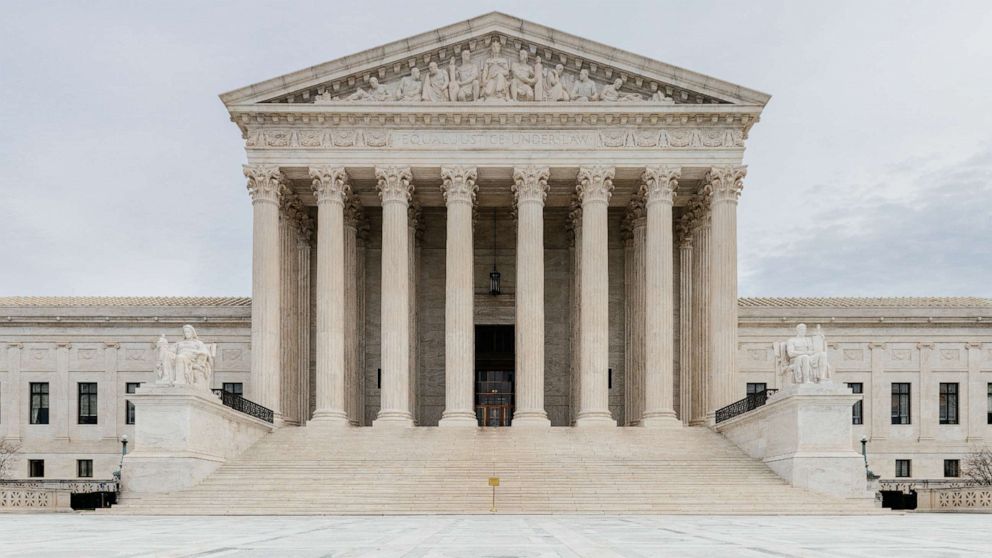
Photo via Fox News

Trump's unusual legal gambit against Biden-era deportation rule pays off at Supreme Court

Read the original at Fox News ↗
Cite

Schmad, R. (2026, October 28). Trump's unusual legal gambit against Biden-era deportation rule pays off at Supreme Court. Fox News. https://www.foxnews.com/politics/trumps-unusual-legal-gambit-against-biden-era-deportation-rule-pays-off-supreme-court

Dated from the outlet's own feed. Check the original for its byline.

Fox News · collected 2026-10-28 · by Robert Schmad

Quick Summary

The Supreme Court has allowed a lower court ruling to stand, which eliminates a 2024 immigration rule established by the Biden administration that permitted certain deportation proceedings to be temporarily paused through "administrative closure." Texas and the Department of Justice agreed in June to vacate this rule, leading three cities with large immigrant populations and an advocacy group to argue they should have standing to intervene and defend the rule. The Supreme Court’s decision does not include any noted dissents but upholds Judge Reed O’Connor's ruling against allowing these entities to challenge the agreement.
Written by AI on 2026-10-31, from this article's own text only (the story summary below draws on all the coverage).
See how they differ ↓

AI analysis

Story summary

The Supreme Court declined on October 27, 2026, to restore a Biden-era policy that allowed immigration judges to use their discretion to temporarily pause deportation proceedings for migrants. Known as "administrative closure," the regulation enabled judges to halt removal cases while migrants sought humanitarian protections or other legal status in the U.S. Texas had sued the federal government in June 2026, arguing that the rule was adopted without proper authority. The Department of Justice then agreed with Texas and asked a judge to eliminate this rule, which led to a lower court ruling against it. This decision now stands without objection from the Supreme Court, leaving the Biden-era policy effectively dismantled.

Written for “Trump Wins At Scotus On Deportation Rule” on 2026-11-22, grounded in this article and the 1 other(s) covering the same event.

How they differ

2 outlets covered “Trump Wins At Scotus On Deportation Rule”.

What each outlet says

One AI summary per outlet of its latest article on this story, written from that article alone and checked against it. Open the article for the outlet's own words.

Fox NewsThis outlet28 Oct

The Supreme Court has allowed a lower court ruling to stand, which eliminates a 2024 immigration rule established by the Biden administration that permitted certain deportation proceedings to be temporarily paused through "administrative closure." Texas and the Department of Justice agreed in June to vacate this rule, leading three cities with large immigrant populations and an advocacy group to argue they should…

Trump's unusual legal gambit against Biden-era deportation rule pays off at Supreme Court (this article)
ABC News (US)27 Oct

The Supreme Court has declined to reinstate a Biden-era policy that allowed immigration judges to use administrative closure, which permits them to temporarily halt deportation cases for immigrants who are seeking legal protections. This regulation was designed to give judges discretion in managing removal proceedings by allowing pauses when migrants need time to secure humanitarian protections or other legal…

SCOTUS won't restore policy that lets immigration judges close deportation cases →

Compared with similar articles

This article reads unscored and hedges 17% of its claims. Each row says how that neighbour differs.
Fox News
Leans right Hedges 6 of 24 claims Outlet record 66/100
“The articles describe different legal actions related to immigration policies: one is about a Fifth Circuit Court of Appeals ruling supporting Trump's administration on bond hearings for detained illegal immigrants, while the other is about the Supreme Court allowing an agreement between Texas and DOJ to end a Biden-era immigration rule.”
ABC News (US)
Leans left Hedges 0 of 4 claims Outlet record 65/100

Story

Trump Wins At Scotus On Deportation Rule
Politics · 2 article(s) covering the same event. See how they differ ↑
How this article was measured signals, leaning charts, publisher record, byline, topics and claims

Signals How these are calculated →

Claims extracted
12
sentences that state something as happening or true
Uncertain
17%
2 of 12 hedged ("reportedly", "may", "according to")
Leaning
withheld
no quote in the article backed the model's score
Publisher signals
66/100
Fox News's corrections and hedging, across everything collected from it. Not a measure of accuracy.
Outlets on this story
2
Politics
Same framing elsewhere
1
articles that frame the event the way this one does
Analyzed 2026-10-31 · how these are computed

How this is being covered How these are calculated →

Article leaning vs. publisher reliability
Source leaning vs. consistency

Publisher

Fox News · 8545 article(s) · 17 correction(s) detected
Running correction rate · 17 correction(s)

Who wrote this

Robert Schmad
58 article(s) here · 1 carrying a prediction
Bloomberg projects that each of Anthropic’s seven co-founders will be worth approximately $24.5 billion now that their artificial intelligence firm has gone public.
If Democrats successfully knock it down a peg, the resulting loss in value could send shockwaves throughout the economy.
The DHS rule would have replaced a longstanding policy by only allowing international students to study in America for fixed timeframes, generally capped at four years, requiring them to apply for an extension if they wish to continue their studies.
Thomas was joined by Justice Samuel Alito in dissenting from the decision, arguing that allowing the law to stand could have implications reaching far beyond the medical field.
In this quest, they may find an unlikely ally in the White House.
Counsel to the president William Scharf sent a letter to House Committee on Oversight and Government Reform ranking member California Democratic Rep. Robert Garcia Nov. 9, warning Democrats against running afoul of their allotted powers pertaining to investigations and subpoenas.
"They are, for us, a little bit like the air we breathe and the water a fish might swim in.
As Republicans reel from their bruising midterm election losses, Supreme Court Justice Sonia Sotomayor is hoping some of the court's biggest conservative rulings will eventually be overturned.
"The T in LGBTQ+ stands for TRANSGENDER," Annie Andrews, who is set to represent a state President Donald Trump won by roughly 18%, posted in 2023.
As results poured in on election night, however, it became clear that even states that practically nobody thought would be competitive, such as Louisiana and Tennessee, were coming within a razor's edge of going blue.
Also by Robert Schmad
Nothing else under this byline is closely related to this article, so these are simply their most recent.
All 58 articles by Robert Schmad →

Topics

Centro Legal de la Raza Texas The Supreme Court The Supreme Court's the Department of Justice

Subjects

Biden PERSON · 5× Texas GPE · 5× Centro Legal de la Raza ORG · 2× The Supreme Court ORG · 2× the Department of Justice ORG · 2× DOJ ORG · 1× George W. Bush PERSON · 1× Reed O’Connor PERSON · 1× The Supreme Court's ORG · 1× the Justice Department ORG · 1×

Narrative

The Biden administration adopted the rule in 2024, formally establishing procedures for immigration judges to temporarily pause certain deportation proceedings through a practice known as "administrative closure," including when migrants were pursuing immigration relief through other federal proceedings.
framing: assertive · carried by 1 article(s) · first seen 2026-10-31
The cities argued that eliminating the rule could lead to residents being deported, reducing their tax revenues and giving them legal standing to challenge the agreement.

Claims (12 extracted, 2 hedged)

The Supreme Court, with no noted dissents, has allowed an agreement between Texas and the Department of Justice ending a Biden-era immigration rule to go into effect. asserted
agreement → note → effect
The Biden administration adopted the rule in 2024, formally establishing procedures for immigration judges to temporarily pause certain deportation proceedings through a practice known as "administrative closure," including when migrants were pursuing immigration relief through other federal proceedings. asserted
migrants → adopt → proceedings
The Supreme Court's move leaves in place a lower court ruling eliminating that rule, stripping away a procedure that allowed certain deportation cases to be put on hold. asserted
cases → leave → hold
Texas sued the federal government in June, arguing that the rule was adopted without proper legal authority. asserted
rule → sue → authority
The Department of Justice agreed with Texas, asking the judge overseeing the case to vacate the rule and prevent similar rules from being adopted in the future. asserted
Department → agree → future
Opponents accused Texas and the Justice Department of colluding to eliminate the Biden-era rule, arguing that the two sides worked together despite being on opposite sides of the lawsuit. asserted
sides → accuse → lawsuit
On the same day the DOJ made its request, District Judge Reed O’Connor, an appointee of President George W. Bush, granted it. asserted
O’Connor → make → it
In August, however, three cities with large immigrant populations — Baltimore, Maryland; New Haven, Connecticut; and Columbus, Ohio — joined with Centro Legal de la Raza, an immigrant legal advocacy group, in an effort to intervene in the case and defend the Biden-era rule on appeal. asserted
cities → join → appeal
The cities argued that eliminating the rule could lead to residents being deported, reducing their tax revenues and giving them legal standing to challenge the agreement. uncertain
residents → argue → agreement
O’Connor rejected that argument. asserted
O’Connor → reject → argument
On Oct. 9, the three cities and Centro Legal de la Raza asked the Supreme Court to temporarily block the lower court's judgment while their appeal proceeded, accusing Texas and the federal government of engaging in "egregious collusion" to eliminate the Biden-era rule. asserted
appeal → ask → rule
Federal lawyers argued that the cities and their allies lacked legal standing to challenge the agreement because they had not demonstrated the concrete injury required for a federal court to consider their claims. uncertain
court → argue → claims
Give feedback · no sign-in needed

No sign-in needed for now. Your note is sent without a name, so it cannot be answered.

History Support