Photo via The Straits Times

US admission of orbital weapons seen as landmark moment in race with China, Russia

Read the original at The Straits Times ↗
Cite

The Straits Times. (2026, September 15). US admission of orbital weapons seen as landmark moment in race with China, Russia. The Straits Times. https://www.straitstimes.com/world/us-orbital-weapons-acknowledgement-a-landmark-move-us-space-command-official-says

Dated when The Aporia collected the article, usually within hours of publication. Check the original for its exact date and byline.

The Straits Times · collected 2026-09-15 · by The Straits Times

Quick Summary

U.S. Space Force Chief Douglas Schiess and Air Force Secretary Troy Meink recently confirmed at a conference near Washington that the Pentagon operates weapons in Earth's orbit, aiming to deter aggressive activities by China and Russia. This admission marks a significant shift towards openly discussing space weaponization despite concerns raised by Chinese and Russian officials about potential arms races and destabilization of outer space.
Written by AI on 2026-09-16, from this article's own text only (the story summary below draws on all the coverage).
See how they differ ↓

AI analysis

Story summary

On September 14, 2026, the United States Space Force confirmed it had deployed weapons into Earth's orbit for the first time. A spokesperson stated that these "on-orbit space control weapons" are designed to defend against hostile actions from adversaries but did not specify the nature of these capabilities. Both China and Russia have been developing their own space and counterspace technologies, posing threats to US interests in space.

In response, China's Foreign Ministry urged the US to halt its military buildup in orbit, warning against an arms race and weaponizing outer space. The Kremlin similarly called for space to remain free of weapons. These developments signal a growing militarization trend in Earth’s orbit, potentially leading to increased tensions between major powers.

The US move comes amid efforts by China and Russia to modernize their militaries with advanced space technologies, viewing space supremacy as crucial for future conflicts. Analysts fear this confirmation will accelerate the arms race in space among these nations.

Written for “US Deploys Space Weapons” on 2026-11-20, grounded in this article and the 23 other(s) covering the same event.

How they differ

14 outlets covered “US Deploys Space Weapons”.

What each outlet says

One AI summary per outlet of its latest article on this story, written from that article alone and checked against it. Open the article for the outlet's own words.

The Straits TimesThis outlet15 Sep

U.S. Space Force Chief Douglas Schiess and Air Force Secretary Troy Meink recently confirmed at a conference near Washington that the Pentagon operates weapons in Earth's orbit, aiming to deter aggressive activities by China and Russia. This admission marks a significant shift towards openly discussing space weaponization despite concerns raised by Chinese and Russian officials about potential arms races and…

US admission of orbital weapons seen as landmark moment in race with China, Russia (this article)2 articles from The Straits Times on this story
The Hindu21 Sep

On September 14, 2026, U.S. Air Force Secretary Troy Meink announced the deployment of "on-orbit space control weapons" aimed at defending against hostile actions, a move confirmed by Space Force chief Gen. Douglas Schiess. This admission raises concerns as it aligns with military doctrines that consider both offensive and defensive operations for space control, complicating international rules governing orbital…

Unsafe space: On the U.S. and ‘on-orbit space control weapons‘ →6 articles from The Hindu on this story
South China Morning Post19 Sep

At Beijing’s Xiangshan Forum, defense experts warned that the United States breaking the taboo by deploying weapons in space could ignite an arms race and destabilize global security. Speakers urged dialogue between the US and China ahead of President Xi Jinping's visit to Washington. The US Air Force Secretary confirmed the Pentagon has deployed space control weapons but did not specify the systems involved.

US space weapons move has ‘broken taboo’, could spark new arms race, Beijing forum told →2 articles from South China Morning Post on this story
BBC15 Sep

The United States recently announced that it has deployed an undisclosed space weapon into Earth’s orbit, though specifics about its capabilities and deployment date remain unclear. The article discusses potential types of weapons, such as electronic warfare platforms or kinetic kill vehicles, which could disrupt or destroy satellites. Experts suggest that while other countries like Russia and China may have similar…

What weapon could the US have put into space? →2 articles from BBC on this story
The Guardian19 Sep

Air force secretary Troy Meink disclosed that the US has deployed weapons in space but provided no details about them. This vague announcement came amid growing concerns over Russian and Chinese activities in outer space and follows President Trump’s initiative to establish Space Force as a new military branch. Experts like Clayton Swope from CSIS speculate that this disclosure is part of a broader strategy to deter…

The US air force admitted to deploying weapons in space. Don’t expect the White House to explain why →2 articles from The Guardian on this story
Washington Examiner18 Sep

The United States has recently confirmed its possession of space weapons, with Air Force Secretary Troy Meink acknowledging that the Space Force has "on-orbit space control weapons." This disclosure follows statements from Gen. Dan Caine emphasizing military preparedness in space. China and Russia have responded critically, urging a halt to military buildup in space due to fears it could escalate into an arms race…

America just admitted it has space weapons. Now, one miscalculated orbit could start World War III →2 articles from Washington Examiner on this story
Show 8 more outlets
Euronews14 Sep

The United States Space Force announced on Monday that the U.S. has deployed weapons into orbit, marking a significant escalation in militarization of space. The statement indicated these capabilities can be used for both offensive and defensive purposes to protect against adversary actions. Countries like China and Russia criticized this move, with Chinese officials urging the U.S. to halt its military buildup in…

United States Space Force says US has weapons in orbit →
Daily Mail15 Sep

The U.S. Air Force has confirmed that the United States deployed its first space weapon in orbit, though details about its offensive capabilities remain undisclosed. Speaking at the Air, Space and Cyber Conference, Secretary Troy Meink stated this deployment is necessary to address evolving threats posed by Russia and China's advancements in space technology aimed at disrupting or attacking U.S. satellites. The…

US confirms for first time it has deployed a space weapon in orbit →
Toronto Star15 Sep

Troy Meinking, the Air Force Secretary, announced at the Air and Space Cyber Conference in Maryland on Monday that the United States now possesses weapons deployed in space for defensive purposes. This marks the first time the U.S. government has officially acknowledged the presence of such capabilities in orbit.

US acknowledges for the first time that it has deployed weapons in space →
Dawn15 Sep

The United States Space Force confirmed on Tuesday that it has deployed weapons in orbit, a move criticized by both Russia and China. Russian spokesperson Dmitry Peskov called for the demilitarization of space, while Chinese foreign ministry spokesman Guo Jiakun warned against turning outer space into a battlefield. The U.S. statement provided no specific details about the type or number of weapons deployed but…

US confirms deployment of orbital weapons, draws ire of Russia and China →
New York Post15 Sep

Air Force Secretary Troy Meink confirmed at an Air & Space Forces Association conference that the US has launched secret weapons into orbit, aimed at countering threats from Russia and China, particularly concerning intelligence provided by satellites to Iran. While details such as the number of weapons or duration in space were not disclosed, Meink emphasized their role in defense against hostile actions. China…

US launches mysterious weapons into space in move against China and Russia, Air Force secretary confirms →
Global News15 Sep

The U.S. Air Force Secretary confirmed at a conference that the U.S. has launched space weapons for the first time, aimed at defending against hostile actions. No specific details were provided about these weapons or their operational nature. An air and space law expert noted that while this confirmation is rhetorically significant, it does not imply any major legal or practical changes since similar technologies…

U.S. confirms space weapons launch for the 1st time. Should you be concerned? →
Time15 Sep

On September 14, Air Force Secretary Troy Meink admitted at an aerospace conference in Maryland that the U.S. military has space-based weapons and intends to defend against threats from orbit. This acknowledgment breaks long-standing policy avoidance of weaponizing space, despite international treaties prohibiting such actions since 1967. The article highlights historical instances of space militarization by the…

The U.S. Just Admitted it Has Weapons in Space. Why That's a Big Deal →
Fox News15 Sep

Air Force Secretary Troy Meink disclosed at the Air & Space Forces Association’s conference in Maryland that the U.S. has weapons currently orbiting Earth to defend against attacks in space. However, Meink did not provide details such as what these weapons are or how they function. This revelation marks a shift towards more openness about U.S. military capabilities in space amid growing concerns over China and…

Pentagon reveals secret space weapons are already in orbit — but won't say what they do →

Where they agree and split

Agreed

AI · cited, from two or more outlets

  • The US Space Force stated that these capabilities can be employed for both offensive and defensive purposes.24
Quoted from the coverage (2)

China, responding to the U.S., said Tuesday, “We urge the U.S. side to stop expanding its military capabilities and preparing for war in outer space,” according to a BBC report citing the AFP.

6 outlets

"These capabilities can be employed for offensive and defensive purposes at the direction of combatant commands."

5 outlets

Disputed

Picked by our model, which is sometimes wrong

  • While the US confirmed deploying space weapons, there is disagreement over whether this action constitutes a significant legal or strategic shift.56
  • Outlets differ on the potential risks and implications of the weapon deployment for international relations and stability in space.57

Framing

How the first headlines put it

  • The BBC headline focuses on the confirmation aspect, while Dawn highlights the reaction from Russia and China.13
  • Global News asks if the public should be concerned about space weapons, whereas The Guardian questions why the White House is not providing more details.56
Attributed to a source4
Stated as fact7
The headlines (11)

United States Space Force says US has weapons in orbit Euronews · attributed to a source

US has weapons deployed in orbit, Space Force says, for ‘offensive and defensive’ use South China Morning Post · attributed to a source

U.S. has weapons deployed in orbit, Space Force says The Hindu · attributed to a source

US has weapons deployed in orbit, Space Force says The Straits Times · attributed to a source

US confirms for first time it has deployed space weapons BBC · stated as fact

US confirms for first time it has deployed a space weapon in orbit Daily Mail · stated as fact

US confirms for first time it has deployed weapons into space The Guardian · stated as fact

Air Force secretary admits US weapons are stationed in outer space Washington Examiner · stated as fact

US acknowledges for the first time that it has deployed weapons in space Toronto Star · stated as fact

US confirms deployment of orbital weapons, draws ire of Russia and China Dawn · stated as fact

US launches mysterious weapons into space in move against China and Russia, Air Force secretary confirms New York Post · stated as fact

Words to watch (3)

The US air force admitted to deploying weapons in space. Don’t expect the White House to explain why The Guardian

Air Force secretary admits US weapons are stationed in outer space Washington Examiner

The U.S. Just Admitted it Has Weapons in Space. Why That's a Big Deal Time

The full story: what happened, how it changed, and all 24 articles →

Compared with similar articles

This article reads unscored and hedges 11% of its claims. Each row says how that neighbour differs.
Euronews
Hedges 0 of 13 claims Outlet record 60/100
South China Morning Post
Centre Hedges 0 of 5 claims Outlet record 62/100
The Straits Times
Leans right Hedges 1 of 8 claims Outlet record 64/100
Toronto Star
Hedges 0 of 2 claims Outlet record 64/100
Dawn
Hedges 4 of 29 claims Outlet record 67/100
BBC News
Hedges 4 of 22 claims Outlet record 65/100
The Hindu
Hedges 1 of 8 claims Outlet record 60/100
Daily Mail
Hedges 2 of 17 claims Outlet record 69/100
The Hindu
Hedges 0 of 10 claims Outlet record 60/100
The Guardian
Leans left Hedges 2 of 29 claims Outlet record 64/100

Story

US Deploys Space Weapons
Politics · 24 article(s) covering the same event. Compare every outlet's account →
How this article was measured signals, leaning charts, publisher record, byline, topics and claims

Signals How these are calculated →

Claims extracted
28
sentences that state something as happening or true
Uncertain
11%
3 of 28 hedged ("reportedly", "may", "according to")
Leaning
withheld
no quote in the article backed the model's score
Publisher signals
64/100
The Straits Times's corrections and hedging, across everything collected from it. Not a measure of accuracy.
Outlets on this story
24
Politics
Same framing elsewhere
1
articles that frame the event the way this one does
Analyzed 2026-09-16 · source text last changed 2026-09-16 · how these are computed

How this is being covered How these are calculated →

Article leaning vs. publisher reliability
Source leaning vs. consistency

Publisher

The Straits Times · 5570 article(s) · 7 correction(s) detected
Running correction rate · 7 correction(s)

Who wrote this

The Straits Times
3829 article(s) here · 1 carrying a prediction
The European leaders were meeting as part of the so-called coalition of the willing, which regularly gathers to discuss ways to protect a postwar Ukraine from future Russian aggression.
US peace negotiator Jared Kushner, at the same event, also said that he and fellow negotiator Steve Witkoff had “gotten the Russians comfortable with the concept that any security guarantee for Ukraine would be based on Article 5”.
Takaichi’s China trip this week was her first since suggesting in 2025 that Japan might intervene militarily if China attempted to take Taiwan by force.
But while some believe the success of the meeting could have a stabilising effect on an international order in turmoil, the broad consensus among analysts is that this first-of-its-kind meeting worked more as a confidence-building exercise between the rival nations rather than an immediate, concrete cure to the world’s ills.
Iraqi security forces will deploy in Jurf al-Sakhar, a stronghold of the Kataib Hezbollah armed group, on Friday, security officials told a press conference, under a compromise deal designed to ease tensions with Iran's most powerful Shi'ite militia ally in the country.
Some analysts said the outcome of the Shenzhen summit may actually diminish Trump’s stature on the world stage as he enters the lame-duck phase of his presidency, while bolstering two of Washington’s main adversaries.
Whether or not the allegation is true, “just the news will definitely influence people’s opinions of women who have broken the ceiling or are trying to.” Asian American women working in tech, civil rights advocacy and academia have felt a sense of dread that this ordeal will diminish how their peers are viewed and treated in their workplaces. It is a reminder that no accomplishments will completely dispel centuries-old stereotypes.
Three killed in missile strikes on Kyiv, mayor says, in biggest attack on bridges
The Bill is backed by both the oil and gas industry and clean energy groups, but opposed by many major environmental organisations. The measure now proceeds to the House of Representatives, where Speaker Mike Johnson, a supporter of the initiative, has predicted he has the votes to pass it. But members on both sides of the aisle, including Minority Leader Hakeem Jeffries, have said they want to make changes to the Bill. Some Republicans, including Representative Chip Roy, policy chair of the ultraconservative House Freedom Caucus, have wavered in their support, saying they have concerns about the legislation’s electric transmission provisions. Some progressive Democrats, meanwhile, have said they oppose the Senate version of the Bill, contending it would weaken environmental laws. Representative Bruce Westerman, the chairman of the House Natural Resources Committee, said on Nov 19 he doubted there would be time to make changes to the Bill before Congress’s term expires at the end of December. “If the Senate gets it done then I think that’s what we’ll have to pass in the House,” Westerman said in an interview before the vote.
Their complaint alleged that supervisors had warned that objections would result in “trouble.”
Also by The Straits Times
Nothing else under this byline is closely related to this article, so these are simply their most recent.
All 3829 articles by The Straits Times →

Topics

China Pentagon Russia U.S. WASHINGTON

Subjects

U.S. GPE · 9× China GPE · 5× Russia GPE · 5× WASHINGTON GPE · 4× Foreign Ministry ORG · 2× PARIS GPE · 2× Palmer PERSON · 2× Pentagon ORG · 2× Schiess PERSON · 2× the Joint Force ORG · 2×

Narrative

Still, the U.S. remarks underscore how quickly developments in spacecraft technologies have escalated into increasingly open preparations for the prospect of conflict extending into space, while battles from Ukraine to the Middle East prove how indispensable satellites have become in supporting modern warfare on Earth. "The acknowledgment of these space-control capabilities is fundamental to ensuring that we prevent deterrence from failing, and that we are postured and ready should deterrence fail to employ them effectively," Richard Palmer, the director of the Capability and Resource Integration Directorate at U.S. Space Command, said on Tuesday.
framing: assertive · carried by 1 article(s) · first seen 2026-09-16
The service will make "disciplined and responsible choices" as it scales its orbital defense arsenal in the coming years, he added.
2026-09-16 · The Straits Times
US admission of orbital weapons seen as landmark moment in race with China, Russia · assertive framing

Claims (28 extracted, 3 hedged)

US admission of orbital weapons seen as landmark moment in race with China, Russia PARIS/WASHINGTON, Sept 15 - asserted
admission → see → China
The U.S. acknowledgment this week that the Pentagon is operating weapons in Earth's orbit marks a landmark moment in space militarization aimed at deterring what U.S. officials describe as aggressive orbital activities from China and Russia, officials and analysts said. asserted
officials → operate → China
U.S. Space Force chief Douglas Schiess said on Tuesday that enlisted members of his military branch "operate on-orbit weapons that can defend the Joint Force against space-enabled attacks." asserted
that → say → attacks
The service will make "disciplined and responsible choices" as it scales its orbital defense arsenal in the coming years, he added. asserted
he → make → years
Schiess' remarks at a conference near Washington came a day after U.S. Air Force Secretary Troy Meink said the U.S. "has on-orbit space control weapons capable of defending the Joint Force against hostile adversary action." asserted
U.S. → come → action
That was the clearest admission yet by a Pentagon official of U.S. weapons in orbit amid rising space tensions with Russia and China. asserted
That → rise → Russia
The remarks this week by Washington's top military-space officials are part of "the increasing comfort level of the U.S. government to speak about aggressive actions in space" that has been building up in recent years, said Victoria Samson, chief director of space security and stability at the nonprofit Secure World Foundation. asserted
Samson → increase → Foundation
"We've gone from not talking about counter-space capabilities... to now saying flat-out we have weapons in space,” Samson said. asserted
Samson → go → space
"The pendulum keeps on shifting over that way." asserted
pendulum → keep → way
Schiess and Meink declined to say what types of weapons they were referring to when they spoke to reporters after their remarks. asserted
they → decline → remarks
Responding to the U.S. admission of orbital weapons, China's Foreign Ministry spokesperson Guo Jiakun said on X that Beijing "stands for peaceful use of the outer space and keeping it safe, and opposes any arms race in outer space or any attempt to weaponize it and turn it into a warzone." Russia's Foreign Ministry said the acknowledgement that Washington had deployed orbital weapons ignored the possible consequences of a conflict and threatened long-term stability in space-based activity. CONFLICTS COULD EXTEND INTO SPACE uncertain
CONFLICTS → respond → SPACE
The U.S., China and Russia - the world's top three space powers - have raced for years to build and deploy an array of satellite networks and maneuverable spacecraft bearing capabilities that could be used to attack or tamper with other spacecraft. uncertain
that → race → spacecraft
But as military norms, strategic precedent and laws of war in the relatively unfamiliar battleground of space remain underdeveloped, no nation is known to have taken the more consequential step of physically attacking another's satellite in space. asserted
nation → remain → space
Still, the U.S. remarks underscore how quickly developments in spacecraft technologies have escalated into increasingly open preparations for the prospect of conflict extending into space, while battles from Ukraine to the Middle East prove how indispensable satellites have become in supporting modern warfare on Earth. "The acknowledgment of these space-control capabilities is fundamental to ensuring that we prevent deterrence from failing, and that we are postured and ready should deterrence fail to employ them effectively," Richard Palmer, the director of the Capability and Resource Integration Directorate at U.S. Space Command, said on Tuesday. asserted
Palmer → underscore → Tuesday
Speaking at a space defence conference hosted by consulting firm Novaspace in Paris, Palmer added that there were “some actors across the globe who are very much interested in undermining the collective interests of the countries and allies gathered here in this audience and across Europe and the rest of the world.” asserted
who → speak → world
He declined to discuss the nature or capability of those weapons. asserted
He → decline → weapons
"The bottom line is that our joint force and our allied forces require space. asserted
force → ally → space
Our economies require space,” added Palmer. asserted
Palmer → require → space
“We are ready in the U.S. to preserve that. asserted
We → preserve → that
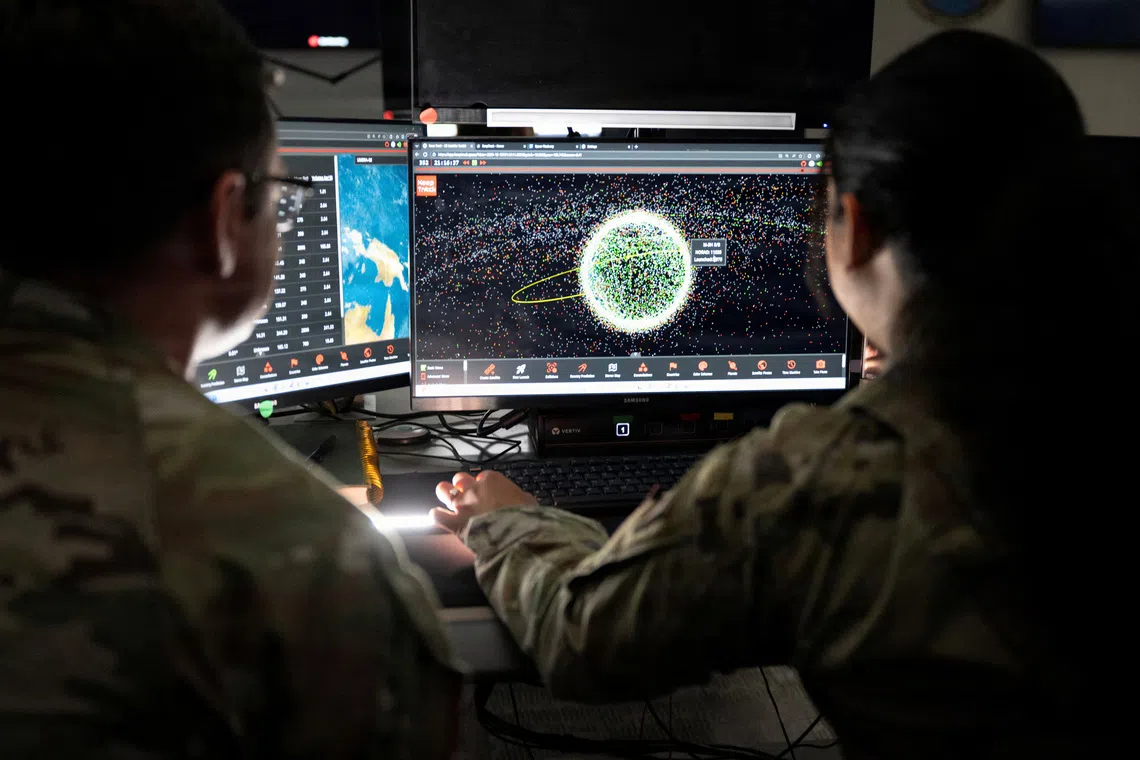
PREPARING FOR WAR IN SPACE For decades, satellites have provided communications, navigation and intelligence services to armed forces on Earth, and once placed in orbit typically remained on fixed paths. Increasingly, however, militaries view them as active weapons platforms capable of launching attacks by disrupting a satellite's operations through signal jamming, using lasers to blind sensors, or even capturing enemy spacecraft. asserted
militaries → prepare → spacecraft
China in 2022 demonstrated it can command a satellite to grapple onto another spacecraft and move it in orbit. asserted
it → demonstrate → orbit
The U.S. recently conducted its largest orbital exercise, called Apollo Maneuvers, designed to demonstrate dynamic space operations. asserted
U.S. → conduct → operations
It involved satellites in multiple orbits simultaneously plus participation from international and commercial partners. asserted
It → involve → partners
Despite the intensifying demonstrations, U.S. officials still have not openly discussed the specific weapons themselves, leaving room for assumptions and interpretations that will shape how U.S. adversaries respond and risk accelerating an arms race in space, said Craig Albert, graduate director of the Master of Arts in Intelligence and Security Studies at Augusta University. asserted
Albert → intensify → University
"In the absence of complete information, competitors may assume the systems threaten their own space assets and invest in counterspace capabilities or comparable weapons," Albert said. uncertain
Albert → assume → capabilities
The head of U.S. Space Command has warned that adversaries are developing capabilities to deny the United States access to key systems and reduce military effectiveness, and that adversaries would likely seek to target U.S. space assets early in a conflict. asserted
adversaries → warn → conflict
Some other countries are also looking to develop counter-space weapons. asserted
countries → look → weapons
That includes Germany, which has a €35-billion ($40-billion) military space spending plan aimed at countering growing threats from adversaries. asserted
which → include → adversaries
Give feedback · no sign-in needed

No sign-in needed for now. Your note is sent without a name, so it cannot be answered.

History Support