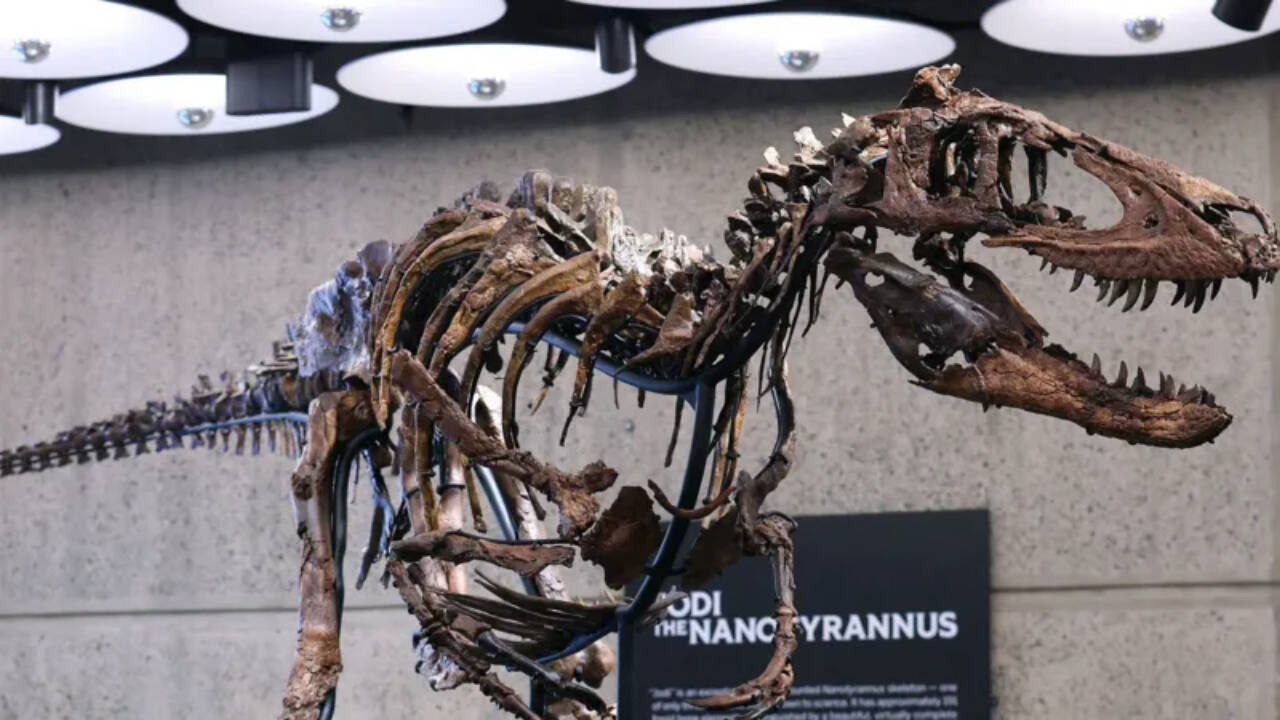
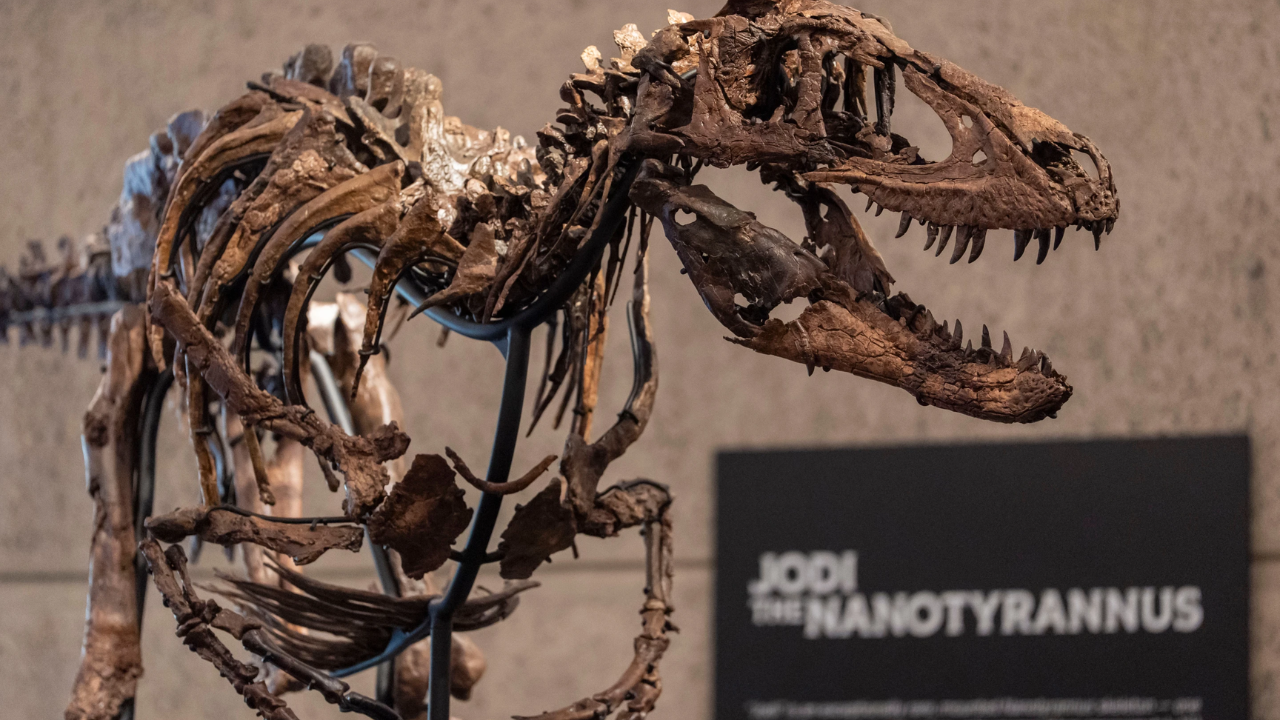
Photo via The Guardian

Rare Nanotyrannus skeleton sells for $47.3m at New York auction

Read the original at The Guardian ↗
Cite

Betts, A., & Amatulli, J. (2026, October 27). Rare Nanotyrannus skeleton sells for $47.3m at New York auction. The Guardian. https://www.theguardian.com/us-news/2026/oct/27/nanotyrannus-dinosaur-fossil-sothebys-auction

Dated from the outlet's own feed. Check the original for its byline.

The Guardian · collected 2026-10-27 · by Anna Betts, Jenna Amatulli

Quick Summary

A rare Nanotyrannus skeleton named "Jodi" sold for $47.3 million at a Sotheby’s auction in New York, far exceeding the initial estimate of $6m to $9m. Discovered by Jodi Pierson in 2019 near Jordan, Montana, the fossil is one of only three known substantial Nanotyrannus skeletons and measures 19.6 feet long. The sale, after a twelve-minute bidding battle involving six bidders, has drawn criticism from some scientists concerned about the impact on museum funding and accessibility.
Written by AI on 2026-10-29, from this article's own text only (the story summary below draws on all the coverage).
See how they differ ↓

AI analysis

Story summary

A rare Nanotyrannus skeleton named "Jodi," discovered in 2019 by Montana rancher Jodi Pierson on her land near the Hell Creek Formation, sold at Sotheby’s auction in New York for a record-breaking $47.3 million, far exceeding its initial estimate of $6 million to $9 million. Unveiled earlier this month in Manhattan, the nearly 70% complete fossil measures approximately 19.6 feet long and is composed of around 191 bone elements. The sale makes Jodi the second-most expensive dinosaur fossil ever sold, behind only the $50.1 million record set by a Tyrannosus rex skeleton called Gus earlier in the year. The buyer remains anonymous, raising concerns among scientists about who should have access to such rare fossils for research and public display.

Written for “Montana Rancher's Dinosaur Fossil Sells For Record Amount” on 2026-11-22, grounded in this article and the 2 other(s) covering the same event.

How they differ

2 outlets covered “Montana Rancher's Dinosaur Fossil Sells For Record Amount”.

What each outlet says

One AI summary per outlet of its latest article on this story, written from that article alone and checked against it. Open the article for the outlet's own words.

The GuardianThis outlet27 Oct

A rare Nanotyrannus skeleton named "Jodi" sold for $47.3 million at a Sotheby’s auction in New York, far exceeding the initial estimate of $6m to $9m. Discovered by Jodi Pierson in 2019 near Jordan, Montana, the fossil is one of only three known substantial Nanotyrannus skeletons and measures 19.6 feet long. The sale, after a twelve-minute bidding battle involving six bidders, has drawn criticism from some…

Rare Nanotyrannus skeleton sells for $47.3m at New York auction (this article)
Times of India28 Oct

A nearly 70%-complete Nanotyrannus skeleton, discovered in Montana by rancher Jodi Pierson on her property in the Hell Creek Formation in 2019, sold for a record $47.3 million at Sotheby’s auction in New York. This exceeds its top estimate of $9 million and makes it the second most expensive dinosaur fossil ever sold, just behind a T. rex skeleton that fetched $50.1 million earlier this year. The specimen, one of…

Montana rancher’s rare dinosaur fossil sells for record $47.3 million at auction →2 articles from Times of India on this story

Compared with similar articles

This article reads unscored and hedges 12% of its claims. Each row says how that neighbour differs.
Times of India
Hedges 4 of 42 claims Outlet record 58/100
Times of India
Hedges 1 of 32 claims Outlet record 58/100

Story

Montana Rancher's Dinosaur Fossil Sells For Record Amount
Science · 3 article(s) covering the same event. See how they differ ↑
How this article was measured signals, leaning charts, publisher record, byline, topics and claims

Signals How these are calculated →

Claims extracted
26
sentences that state something as happening or true
Uncertain
12%
3 of 26 hedged ("reportedly", "may", "according to")
Leaning
not political
takes no side on a contested political question
Publisher signals
63/100
The Guardian's corrections and hedging, across everything collected from it. Not a measure of accuracy.
Outlets on this story
3
Science
Same framing elsewhere
1
articles that frame the event the way this one does
Analyzed 2026-10-29 · how these are computed

How this is being covered How these are calculated →

Article leaning vs. publisher reliability
Source leaning vs. consistency

Publisher

The Guardian · 2689 article(s) · 10 correction(s) detected
Running correction rate · 10 correction(s)

Who wrote this

Anna Betts
25 article(s) here · 1 carrying a prediction
They said that they wanted to “understand whether any actions or decisions by Secretary Lutnick concerning export controls, enforcement measures, or national security policies may have been improperly influenced by Cantor Fitzgerald’s holdings or business interests”.
The Republican leader, who informed aides on 4 November that he would not seek re-election for House leadership, said on Saturday that he reached the decision “pretty quickly after election night”. “We worked around the clock, left it all on the field to win.
The longest nationwide group stop in 25 years left passengers stranded at airports across the country, with no certainty about exactly when they may reach their intended destination.
“The only way people will pay attention, you have to do something,” Ferguson said he told her.
Comer also urged Congress to pass legislation he introduced that he said would “ensure witnesses and survivors and sexual crimes are not deterred from speaking freely by nondisclosure agreements”.
He also argued that the subpoenas would “expose women who value their privacy, who have no known or public connection to Epstein”.
Officials said they are working with public health partners to identify and contact any individuals “who may have been in close contact with the person to monitor for symptoms”.
Elliott said that the crash site had since been “turned over to the Federal Aviation Administration (FAA) and the National Transportation Safety Board (NSTB)”, which will investigate the collision.
Sotheby’s initially estimated that the skeleton would sell for $6m to $9m.
The case is ongoing and the DoJ recently filed a motion to dismiss, arguing that “decisions about law-enforcement information sharing are committed to the agency’s discretion” and that turning over unredacted files would violate victims’ privacy.
Also by Anna Betts
Nothing else under this byline is closely related to this article, so these are simply their most recent.
All 25 articles by Anna Betts →
Jenna Amatulli
1 article(s) here · 1 carrying a prediction
Sotheby’s initially estimated that the skeleton would sell for $6m to $9m.
The only article under this byline in the corpus.

Topics

Garfield County Manhattan Montana New York Sotheby’s

Subjects

Sotheby’s ORG · 9× Jodi PERSON · 5× Cassandra Hatton PERSON · 1× Garfield County GPE · 1× Hatton PERSON · 1× Jodi Pierson PERSON · 1× Jordan ORG · 1× Manhattan GPE · 1× Montana GPE · 1× New York GPE · 1×

Narrative

“Now maybe the as-yet unidentified purchaser will donate it to a museum or similar institution, where the public can see it and where scientists now and in future generations can measure the bones, take samples and scans of the fossils, and apply current analytical procedures (as well as procedures no one has dreamed of yet) to help us better understand the biology of these ancient animals.
framing: assertive · carried by 1 article(s) · first seen 2026-10-29
Sotheby’s initially estimated that the skeleton would sell for $6m to $9m.
2026-10-29 · The Guardian
Rare Nanotyrannus skeleton sells for $47.3m at New York auction · assertive framing

Claims (26 extracted, 3 hedged)

A rare skeleton of a Nanotyrannus, a smaller relative of the Tyrannosaurus rex, sold at auction in New York this week for $47.3m, making it one of the world’s most expensive fossils. asserted
it → sell → fossils
The skeleton, named “Jodi” after the person who found the remains in 2019, sold at Sotheby’s on Tuesday for $47.3m, “after a twelve-minute bidding battle that saw six bidders compete online and over the phones, before ultimately selling on the phone”, Sotheby’s said in a statement. asserted
Sotheby → name → statement
Sotheby’s initially estimated that the skeleton would sell for $6m to $9m. asserted
skeleton → estimate → 9
Tuesday’s result makes “Jodi” the “second most valuable dinosaur ever sold at auction”, Sotheby’s noted. asserted
Sotheby → make → auction
The buyer has not yet been identified publicly. asserted
buyer → identify → ?
The skeleton, which was unveiled at a Manhattan auction earlier this month, was discovered by Jodi Pierson in 2019 on her privately owned land in the Hell Creek Formation in Garfield County, Montana, near the town of Jordan. asserted
which → unveil → Jordan
According to Sotheby’s, the skeleton measures 19.6ft long from nose to the tail, and around 9.6ft tall on the armature, “comprising approximately 191 fossil bone elements”. uncertain
skeleton → accord → elements
In a statement on Tuesday, Cassandra Hatton, vice-chair and worldwide head of science and natural history at Sotheby’s, thanked the team who assisted in the efforts to “excavate and save ‘Jodi’”. asserted
who → thank → Jodi
“Their passion and expertise have been fundamental to Jodi’s story,” Hatton said. asserted
Hatton → say → story
“From the discovery and excavation, their commitment to understanding and preserving this remarkable specimen has helped bring us to this moment, a testament to the fact that we can all make major contributions to science. asserted
we → understand → science
This exceptional result is a wonderful recognition of that work, and of the enduring fascination with the Nanotyrannus.” asserted
result → endure → Nanotyrannus
“Jodi” is one of only “three substantial Nanotyrannus skeletons known to science, and the first to come to market since the genus was confirmed last fall”, per Sotheby’s. asserted
genus → know → Sotheby
Judging from the overall size and degree of bone development, “it can be determined that the skeleton belonged to an adult individual”, according to a description on Sotheby’s website. uncertain
skeleton → judge → website
Sotheby’s described the nanotyrannus as “a fast, highly specialized carnivorous tyrannosaurid that lived alongside Tyrannosaurus rex at the end of the Cretaceous, about 67 million years ago”. asserted
that → describe → Cretaceous
It added that “previously hypothesized by some to be adolescent T rex, Nanotyrannus has been shown to have over 150 morphological differences that distinguish it from its much larger cousin”. asserted
that → add → cousin
The sale and cost of the fossil has prompted criticism from some in the science community. asserted
sale → prompt → community
Thomas R Holtz Jr, author and principal lecturer on vertebrate paleontology at the University of Maryland, said that as a “tyrannosaur researcher”, his “concerns about the sale of Jodi are the same general concerns about all these multimillion-dollar sales of fossils. asserted
concerns → say → fossils
“At the same time this sale went on, some museums are closing (the Academy of Natural Sciences at Drexel in Philadelphia) or being threatened with closure (the Sternberg Museum of Natural History at Fort Hays State University) because of cost overruns literally only 1/10th that of the final cost of Jodi. asserted
museums → go → Jodi
“So a person really interested in paleontology could do vastly more good by supporting the ongoing operations of multiple museums than the sale of one specimen. uncertain
person → do → specimen
So a well-funded museum would be able to gather multiple good skeletons for the price of this one ‘trophy.’” asserted
museum → fund → trophy
He also emphasized that “potentially scientifically significant fossils” like Jodi “can be lost to research and the public when they are in private hands”. asserted
they → emphasize → hands
“Now maybe the as-yet unidentified purchaser will donate it to a museum or similar institution, where the public can see it and where scientists now and in future generations can measure the bones, take samples and scans of the fossils, and apply current analytical procedures (as well as procedures no one has dreamed of yet) to help us better understand the biology of these ancient animals. asserted
us → donate → animals
But if it simply graces the lobby or ballroom of one of some billionaire’s mansions, unseen and unaccessible to all but their friends, servants and so forth asserted
it → grace → friends
, it is effectively lost to both the public and the scientific community. asserted
it → lose → public
In fact, at that point, it is no different than if it had just been left in the ground,” he said. asserted
he → leave → ground
Linda Ivany, a professor of evolutionary paleoecology at Syracuse University, echoed similar sentiments to the the New York Times: “These amazing fossils should stay in the public sphere for scientists to study, for children to be awed and inspired, and for everyone to be able to marvel at worlds long past and what we can learn from them.” asserted
we → echo → them
Give feedback · no sign-in needed

No sign-in needed for now. Your note is sent without a name, so it cannot be answered.

History Support