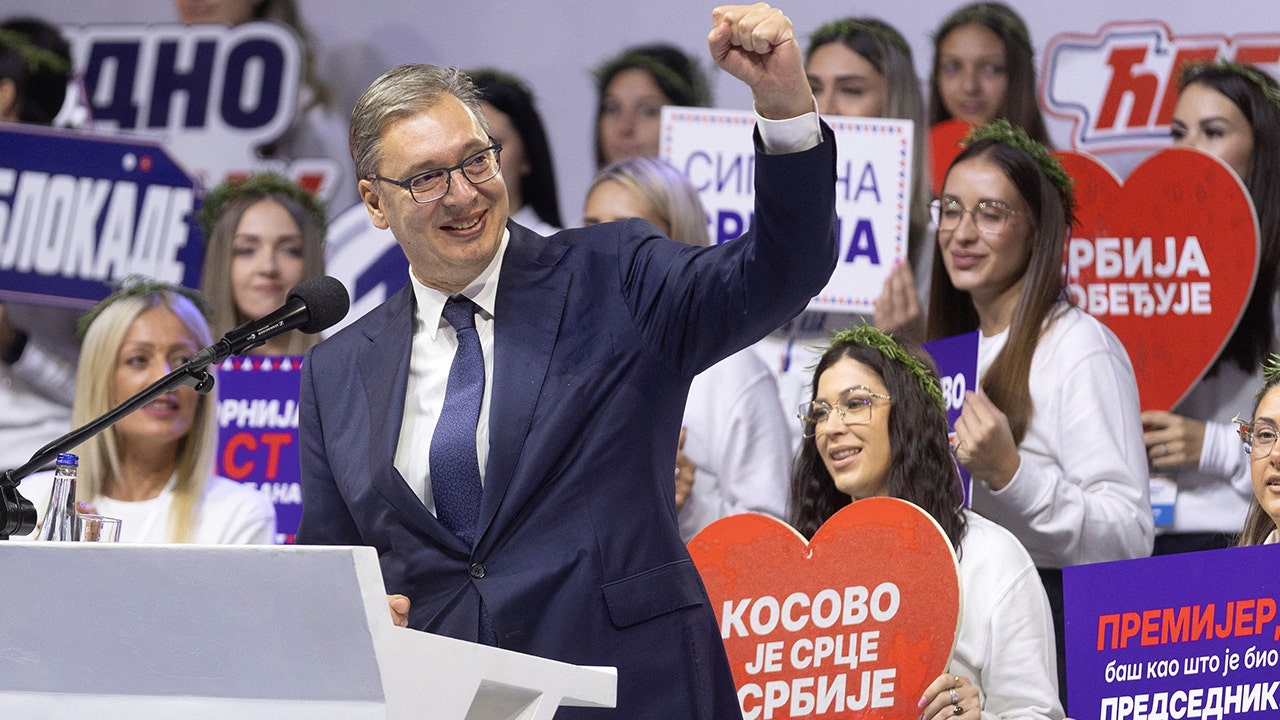
Photo via Al Jazeera

What Vucic’s defeat means for Serbia’s foreign policy

Read the original at Al Jazeera ↗
Cite

Pejovic, M. (2026, October 26). What Vucic’s defeat means for Serbia’s foreign policy. Al Jazeera. https://www.aljazeera.com/news/2026/10/26/what-vucics-defeat-means-for-serbias-foreign-policy?traffic_source=rss

Dated from the outlet's own feed. Check the original for its byline.

Al Jazeera · collected 2026-10-26 · by Mario Pejovic

Quick Summary

Serbia's recent election marked the end of Aleksandar Vucic's 14-year rule as the country transitions to a new political era led by the opposition Student List. International observers are questioning whether this change will lead to a shift in Serbia’s foreign policy, particularly towards improving relations with its neighbors including Bosnia and Herzegovina, Croatia, Montenegro, and Kosovo. However, experts warn that addressing domestic issues such as institutional reforms within the judiciary, prosecution service, police, and media sector will take precedence over any immediate changes in foreign policy.
Written by AI on 2026-10-26, from this article's own text only (the story summary below draws on all the coverage).
See how they differ ↓

AI analysis

Story summary

On October 29, 2026, Serbia's student movement demanded the resignations of top officials in the police, intelligence agencies, and judiciary after winning a historic election against former leader Aleksandar Vucic. The movement, known as "The Students’ List," secured victory on October 25, marking a significant shift in Serbia’s political landscape. Earlier, around 150,000 supporters gathered for the final rally in Belgrade before the election, seeking to oust Vucic's party. The election was seen as one of the most competitive in recent history due to close polling between Vucic’s SNS and the Students’ List. After the victory, the new MPs called for swift action against corruption and demanded that key institutions be cleansed of officials linked to past regimes. This movement follows nearly two years of student-led protests initiated by a canopy collapse at a railway station in Novi Sad in 2024, which killed 16 people.

Written for “Serbia's Student List Triumph” on 2026-11-20, grounded in this article and the 56 other(s) covering the same event.

How they differ

21 outlets covered “Serbia's Student List Triumph”.

What each outlet says

One AI summary per outlet of its latest article on this story, written from that article alone and checked against it. Open the article for the outlet's own words.

Al JazeeraThis outlet26 Oct

Serbia's recent election marked the end of Aleksandar Vucic's 14-year rule as the country transitions to a new political era led by the opposition Student List. International observers are questioning whether this change will lead to a shift in Serbia’s foreign policy, particularly towards improving relations with its neighbors including Bosnia and Herzegovina, Croatia, Montenegro, and Kosovo. However, experts warn…

What Vucic’s defeat means for Serbia’s foreign policy (this article)9 articles from Al Jazeera on this story
The Straits Times28 Oct

Serbia faces a leadership transition following the resignation of former President Aleksandar Vucic after losing power in snap elections on October 28. Among the potential new leaders are Dejan Soskic, a former central bank governor and economist who opposes systemic corruption, and Ilija Srdanovic, a cardiologist and professor advocating for a decentralized health system. Both candidates have been active in the…

The banker, the basketball star, the cardiologist and the chemist: meet Serbia's potential new leaders →11 articles from The Straits Times on this story
The Guardian30 Oct

In Belgrade’s Pioneers Park, members of the Student List, who recently won Serbia's election, gathered to outline their plans for cleaning up corrupt institutions. They called for the dismissal of several senior law enforcement officials and the resignation of the director of Serbia’s internal intelligence agency. The movement also stressed its commitment to anti-corruption efforts and ensuring that prosecutors and…

‘Swift justice’: Student List supporters focus on cleaning up Serbia’s rotten institutions →7 articles from The Guardian on this story
Toronto Star26 Oct

Aleksandar Vucic, Serbia’s long-standing authoritarian leader who ruled for 14 years, conceded defeat in Sunday’s election to a grassroots movement led by university students. Despite Vucic’s aggressive campaign tactics, including favorable state media coverage and populist promises, the diverse youth movement successfully campaigned against rampant corruption and cronyism under his leadership. The student protests…

Serbia's political veteran Vucic outplayed all opponents. Then the students came →4 articles from Toronto Star on this story
BBC30 Oct

Serbia's newly elected student-led movement, which defeated President Aleksandar Vučić's ruling party, is demanding the immediate dismissal of top officials in the police and intelligence agencies. The movement, known as the Student List, is also calling for an investigation into corruption following a tragic railway station collapse that killed 16 people last year in Novi Sad. Newly elected MPs have vowed to…

Student-backed election winners demand sweeping resignations in Serbia →4 articles from BBC on this story
The Independent28 Oct

Serbia recently held snap elections resulting in the ousting of right-wing populist leader Aleksandar Vucic, who conceded defeat after his party received fewer votes than a student-led anti-corruption movement that garnered 2.25 million votes compared to the ruling party's 1.67 million. The winning movement will now select new leaders for key government positions, including the prime minister role, which is…

From basketball stars to bankers: Meet Serbia's new leaders after historic student movement →4 articles from The Independent on this story
Show 15 more outlets
Euronews25 Oct

Crowds celebrated in Belgrade after President Vučić admitted defeat in parliamentary elections. Election officials counted ballots as voting concluded, and preliminary figures showed the highest voter turnout in over three decades. The election followed widespread protests that began after a railway station disaster in November 2024, which highlighted public anger over corruption and poor governance. Students played…

Serbia: crowds celebrate in Belgrade after Vučić admits defeat →2 articles from Euronews on this story
The Hindu29 Oct

Serbian students, part of the Students’ List movement, demanded on October 29, 2026, that top officials in the police, intelligence agencies, and judiciary resign following their electoral victory against long-time leader Aleksandar Vucic. The students urged Serbia’s election authorities to finalize results from the previous Sunday's (October 25) ballot so a new government could be formed. They also called for…

Serbia’s students demand resignations in police, judiciary as they prepare to take power →2 articles from The Hindu on this story
Washington Examiner27 Oct

A student movement unexpectedly defeated Serbian President Aleksandar Vucic, ending his 14-year tenure in power. Vucic had been dominant since becoming leader of the Serbian Progressive Party in 2012 and held various roles including prime minister before switching to president in 2017. Serbia's strategic position between Russia, Europe, China, and the U.S. has made it a critical player in international relations…

Longtime Serbian leader Vucic’s defeat at the hands of student movement leaves Washington in awkward position →2 articles from Washington Examiner on this story
Fox News23 Oct

Serbian President Aleksandar Vucic resigned from his presidential position and is now running for prime minister ahead of upcoming parliamentary elections, seen as one of the most competitive in recent years. Student protesters are mounting a significant challenge against Vucic’s long-standing rule, though Foreign Minister Marko Djuric remains confident that the established leader will prevail due to public support…

Serbia’s longtime leader faces biggest political test as students mount election challenge →
ABC News (AU)25 Oct

Serbian President Aleksandar Vucic conceded defeat to the opposition student-led movement called The Student List following parliamentary elections. Vucic stated that The Student List would secure between 135 and 140 seats, while his party would hold only 105. The high voter turnout of nearly 70% was noted as the highest since Yugoslavia's dissolution in 1992.

Breaking: Serbian president concedes defeat to student-led movement in election →
CBC25 Oct

Aleksandar Vucic, Serbia’s long-standing leader, conceded defeat in Sunday’s election to a student-led opposition movement, marking an end to his political dominance and ushering in a new era for the Balkan country. The election saw nearly 70% voter turnout, with preliminary results showing that the student-led group will have between 135 and 140 seats in parliament compared to Vucic’s party securing around 105…

Serbia's longtime strongman Vucic concedes election defeat to student-led opposition →
CBS News25 Oct

Aleksandar Vucic conceded defeat in Serbia’s parliamentary election on Sunday, projecting that the Students' List will secure between 135 and 140 seats while his Serbian Progressive Party (SNS) is expected to have around 105. The election, characterized by high voter turnout and tension, saw accusations of corruption against Vucic’s government and protests led by university students over the past two years. With a…

Vucic concedes defeat in Serbia's parliamentary election →
Daily Mail25 Oct

Serbia's long-time leader Aleksandar Vucic conceded defeat to a student-led protest movement after Sunday’s parliamentary election, marking a significant political shift in the Balkans nation. The contest primarily pitted Vucic's right-wing Serbian Progressive Party against the Student List, comprising 250 diverse figures selected by university students protesting against Vucic for nearly two years. With high voter…

Serbia's long-standing leader concedes defeat to student-led protest movement →
Global News25 Oct

Aleksandar Vucic, the long-serving leader of Serbia, conceded defeat in Sunday's parliamentary election to a student-led opposition movement after 14 years in power. The Students’ List is projected to win between 135 and 140 seats out of 250, while Vucic’s Serbian Progressive Party (SNS) is expected to secure around 105 seats. Despite his loss, Vucic accused independent media and unnamed European countries of…

Serbia’s Vucic concedes defeat against student-led opposition movement →
Mother Jones25 Oct

Aleksandar Vucic, Serbia’s nationalist leader who has aligned himself with figures like Donald Trump and Vladimir Putin, conceded defeat in Sunday's elections to an anti-corruption movement led by students. The opposition won despite concerns of voter suppression and fraud; Vucic had long dominated Serbian politics since 2012 but faced criticism over his downplay of war crimes from the 1990s. His campaign included…

A Serbian Nationalist Leader Who Courted MAGA Just Lost in a Landslide →
Times of India25 Oct

In Serbia’s recent parliamentary election, long-time leader Aleksandar Vucic conceded defeat to a student-led opposition movement called the Students’ List. With projections showing the Students’ List winning between 135 and 140 seats out of 250 in Parliament, compared to around 105 for Vucic’s Serbian Progressive Party (SNS), celebrations erupted across Belgrade as thousands celebrated in the streets. The movement…

Serbia’s Vucic concedes defeat as student-led movement wins parliamentary election →
Dawn26 Oct

Serbia's student-led protest movement, which began in November 2024 following a tragic train station canopy collapse that killed 16 people, has won a significant victory by ending Aleksandar Vucic’s 14-year rule. The movement, known as the Students’ List and characterized by collective leadership, ran an election campaign focused on corruption, the rule of law, and press freedom. Despite not having named a specific…

From protests to power: How Serbia's students triumphed →
Los Angeles Times26 Oct

In Serbia, after two years of protests led by students accusing Aleksandar Vucic of authoritarianism and corruption, his political opponents won a major election victory, leading to celebrations in Belgrade as the youth movement dismantled pro-Vucic encampments. This youth-driven change mirrors recent events in Hungary, where similar anti-corruption campaigns succeeded in ousting Prime Minister Viktor Orbán after 16…

In Serbia and Hungary, groundswells of youthful energy topple entrenched governments →
Letters from an American28 Oct

On October 27, 2026, Serbian TV apologized for biased reporting during the rule of President Aleksandar Vučić, who was recently ousted by a student-led movement. Meanwhile, leftist candidate Luiz Inácio Lula da Silva won Brazil's presidential election against right-wing candidate Flávio Bolsonaro with over four million more votes than expected, despite Meta’s alleged bias in favor of Bolsonaro on social media…

October 27, 2026 →
South China Morning Post28 Oct

Serbia's recent election loss by nationalist leader Aleksandar Vucic has led to large public celebrations across Belgrade and is expected to increase scrutiny on Chinese investments in Serbia. However, experts predict that this shift will not fundamentally alter the long-standing cooperative relationship between China and Serbia. The political change follows 14 years of Vucic's rule and marks a significant moment…

Why China ties with Serbia face scrutiny, not severance, after historic Vucic loss →

Where they agree and split

Agreed

AI · cited, from two or more outlets

  • The election is seen as a referendum between Vucic’s Serbian Progressive Party and the youth-backed Students' List.12
  • Vucic conceded defeat, citing preliminary results showing his party losing to the student movement.23
Quoted from the coverage (4)

In the lead-up to Sunday’s vote, both international and local election monitors expressed concerns about detentions and reports of surveillance and cyber-attacks against activists.

7 outlets

"We still do not have final results [but] on the basis of a sample … it is clear that we have lost these elections," Mr Vucic said on Sunday.

7 outlets

Vilified by pro-government media, students have cycled and walked through the country to reach voters in rural areas — Vucic’s traditional strongholds.

6 outlets

Recent elections have been marred by irregularities and the European Union is watching closely the conduct of Sunday’s vote in a candidate nation for the bloc’s membership.

5 outlets

Framing

How the first headlines put it

  • The Toronto Star headline focuses on the election as a showdown between Vucic and protesting students, while ABC News highlights Vucic's concession to the student-led movement.12
  • CBS News emphasizes the seismic political shift caused by Vucic’s defeat, whereas The Straits Times focuses on whether the student movement can govern effectively.56
Words to watch (2)

‘It’s the smell of freedom’: Belgrade cleans up after Student List triumph The Guardian

Serbia: crowds celebrate in Belgrade after Vučić admits defeat Euronews

The full story: what happened, how it changed, and all 57 articles →

Compared with similar articles

This article reads leans left and hedges 6% of its claims. Each row says how that neighbour differs.
Mother Jones
Leans strongly left further left than this Hedges 1 of 22 claims Outlet record 60/100
The Straits Times
Hedges 3 of 18 claims Outlet record 64/100
“The articles cover different aspects of the same general political change but describe distinct events or analyses rather than the exact same occurrence.”
The Straits Times
Hedges 1 of 31 claims Outlet record 64/100
Al Jazeera
Leans left Hedges 0 of 4 claims Outlet record 60/100
Washington Examiner
Leans left Hedges 0 of 3 claims Outlet record 67/100
Washington Examiner
Hedges 0 of 5 claims Outlet record 67/100
The Independent
Leans left Hedges 2 of 35 claims Outlet record 59/100
Fox News
Leans left Hedges 3 of 41 claims Outlet record 66/100
“Article A discusses the lead-up to and expectations of the election challenge against Vucic, while Article B covers the outcome and implications of a historic victory for the opposition in Sunday’s election.”
Al Jazeera
Leans left Hedges 1 of 2 claims Outlet record 60/100
“While both articles discuss the election results and their implications for Serbia's future under Vucic's potential removal from power, Article A covers the actual voting day and protests leading up to it, whereas Article B focuses on the aftermath and foreign policy ramifications.”
The Guardian
Leans strongly left further left than this Hedges 1 of 16 claims Outlet record 64/100
“Article A describes Aleksandar Vučić's political history and upcoming election, while Article B discusses the outcome of a recent election where he was defeated.”

Story

Serbia's Student List Triumph
Politics · 57 article(s) covering the same event. Compare every outlet's account →
How this article was measured signals, leaning charts, publisher record, byline, topics and claims

Signals How these are calculated →

Claims extracted
36
sentences that state something as happening or true
Uncertain
6%
2 of 36 hedged ("reportedly", "may", "according to")
Leaning
Leans left
of the writing, not the subject · beta estimate
Publisher signals
60/100
Al Jazeera's corrections and hedging, across everything collected from it. Not a measure of accuracy.
Outlets on this story
57
Politics
Same framing elsewhere
1
articles that frame the event the way this one does
Analyzed 2026-10-26 · how these are computed

How this is being covered How these are calculated →

Article leaning vs. publisher reliability
Source leaning vs. consistency

Publisher

Al Jazeera · 6159 article(s) · 4 correction(s) detected
Running correction rate · 4 correction(s)

Who wrote this

Mario Pejovic
4 article(s) here · 1 carrying a prediction
As Belgrade prepares for a turbulent transition and the upcoming presidential elections in December, international observers and regional neighbours have been asking whether Vucic’s departure will prompt a shift in Serbia’s foreign policy.
What initially began as a targeted environmental protest in May has rapidly escalated into one of the most serious political challenges facing Prime Minister Edi Rama in his more than a decade in power. Yet, as the unrest reaches a boiling point, a fundamental question remains: Who is behind this movement, and can it force systemic political change?
Lawmakers elected Justina Shiroka Pula to the country’s top office in the first minutes of Wednesday, close to the constitutional deadline, averting new early parliamentary elections that could have pushed the country into a deeper crisis.
He said that if a president is not elected by midnight, a new vote will take place in a tense political climate.
Also by Mario Pejovic
Nothing else under this byline is closely related to this article, so these are simply their most recent.

Topics

Belgrade Croatia SNS Serbia Zagreb

Subjects

Serbia GPE · 10× Vucic PERSON · 7× Belgrade GPE · 4× Croatia GPE · 4× SNS ORG · 4× Popov PERSON · 3× Zagreb GPE · 3× Al Jazeera ORG · 2× Bosnia GPE · 2× Montenegro GPE · 2×

Narrative

Aleksandar Popov, director of the Centre for Regionalism in Novi Sad in Serbia, told Al Jazeera that a rapid reset in regional relations was unlikely. “These questions will not be on the agenda immediately,” he said, referring to relations with Serbia’s neighbours.
framing: assertive · carried by 1 article(s) · first seen 2026-10-26
As Belgrade prepares for a turbulent transition and the upcoming presidential elections in December, international observers and regional neighbours have been asking whether Vucic’s departure will prompt a shift in Serbia’s foreign policy.
2026-10-26 · Al Jazeera
What Vucic’s defeat means for Serbia’s foreign policy · assertive framing

Claims (36 extracted, 2 hedged)

Serbia has reached a watershed moment following 14 years of authoritarian rule by Aleksandar Vucic and his Serbian Progressive Party (SNS). asserted
Serbia → reach → Vucic
Sunday’s election delivered a historic victory for the opposition Student List, ending the political dominance that Vucic and the SNS had exercised/enforced for 14 years. asserted
Vucic → deliver → years
As Belgrade prepares for a turbulent transition and the upcoming presidential elections in December, international observers and regional neighbours have been asking whether Vucic’s departure will prompt a shift in Serbia’s foreign policy. asserted
departure → prepare → policy
However, while international analysts often anticipate a quick foreign policy pivot toward the West whenever an authoritarian regime falls, experts warn that internal consolidation will take immediate priority and any transformation will be gradual. asserted
transformation → anticipate → priority
Domestic cleanup before regional reset SNS’s defeat has brought a mixture of cautious optimism and uncertainty across the Western Balkans. asserted
defeat → bring → Balkans
Serbia’s relations with Bosnia and Herzegovina, Croatia, Montenegro and Kosovo have often been frayed by Vucic’s nationalistic rhetoric. asserted
relations → fray → rhetoric
Aleksandar Popov, director of the Centre for Regionalism in Novi Sad in Serbia, told Al Jazeera that a rapid reset in regional relations was unlikely. “These questions will not be on the agenda immediately,” he said, referring to relations with Serbia’s neighbours. asserted
he → tell → neighbours
The new authorities will first have to tackle domestic problems, he said, including dealing with a system that has “captured all democratic institutions”, as well as problems in the judiciary, prosecution service, police and media sector. asserted
that → have → judiciary
“Tidying up at home” will take priority before “solving problems with the neighbours”, Popov said, despite noting that the outgoing regime had done everything possible to undermine regional relations. asserted
regime → tidy → relations
While relations with Croatia are “not frozen” neither are they “the way they should … be between neighbours”, being marked by frequent sharp words. asserted
they → mark → words
Amid recent mass protests in Serbia, Vucic accused Zagreb of organising a “colour revolution”. asserted
Vucic → accuse → revolution
In addition, “relations with Montenegro are disrupted and issues with Bosnia and Herzegovina remain unresolved,” he said. asserted
he → disrupt → Bosnia
Stabilising the region Croatia is the thorniest case, Popov suggested, noting that relations deteriorated as the SNS clashed with Croatia’s ruling Croatian Democratic Union (HDZ), which stems from a similar nationalist-populist stable. “Zagreb would fire a poisoned arrow at Serbia and that gave Belgrade an argument to retaliate,” he said, describing a system that “functioned on the production of internal and external enemies”. uncertain
that → stabilise → enemies
Meanwhile, behind the public hostility, lay a quiet convergence on Bosnia and Herzegovina, he argued, with Belgrade backing Republika Srpska leader Milorad Dodik and Zagreb favouring a third entity. asserted
Zagreb → lie → entity
He expressed hope that a new government in Serbia led by experts and civic leaders, would work towards stabilising the region and revive Serbia’s hopes of joining the European Union. asserted
government → express → Union
“The previous government sabotaged EU integration and the EU will not accept a country without good neighbourly relations. asserted
EU → sabotage → relations
The new government’s task will be to repair those damaged ties,” Popov said. asserted
Popov → repair → ties
Russia and Ukraine Beyond the immediate neighbourhood, global powers are closely watching Belgrade. asserted
powers → watch → Belgrade
Under Vucic, Serbia maintained a delicate balancing act, refusing to impose sanctions on Russia despite heavy pressure from the EU, while simultaneously allowing ammunition to flow indirectly to Ukraine. asserted
ammunition → maintain → Ukraine
Of all elements of Serbian public policy, foreign policy will transform the least under the forthcoming governmental changes, Vuk Vuksanovic, a lecturer in foreign policy at King’s College London, predicted to Al Jazeera. asserted
Vuksanovic → transform → Jazeera
“Many international and domestic structures that shape Serbian foreign policy will remain in place,” he said, adding that Moscow never fully trusted Vucic, but viewed him instead as “the devil they knew”. asserted
they → shape → devil
Russian influence will take a blow, with the end of uncritical glorification of Moscow in Vucic-controlled tabloids and media and intelligence cooperation to be downgraded, he said, but the new government is unlikely to adopt a hawkish stance overnight. asserted
government → take → stance
Serbian interests can continue to be served by ties with Russia, he asserted. asserted
he → continue → Russia
“The country still needs preferential gas prices, the Kosovo dispute remains unresolved and parts of the public remain disillusioned with the West.” asserted
parts → need → West
“The new Serbian government will not see value in joining EU sanctions or adopting a hawkish stance toward Moscow,” Vuksanovic continued. asserted
Vuksanovic → see → Moscow
“Regarding Ukraine, Serbia will maintain its policy of not recognising the annexation of Crimea and Donbas. asserted
Serbia → regard → Crimea
However, there is a question mark over ammunition deliveries, as the opposition viewed Vucic’s weapons sales to Kyiv as a cynical ploy to buy Western tolerance for his domestic rule. asserted
opposition → be → rule
Under Vucic, Serbia established a strong partnership with Prime Minister Benjamin Netanyahu’s government, marked by arms trade and technology exchanges. asserted
Serbia → establish → trade
Bosko Jaksic, a foreign policy analyst, told Al Jazeera that while ties will not be severed, recent controversial agreements will face scrutiny. asserted
agreements → tell → scrutiny
“The new government has no reason to abandon cooperation with Israel, but it will certainly re-examine newly concluded contracts – primarily those concerning Serbian ammunition exports to Israel and Israeli surveillance equipment exports to Serbia,” Jaksic said. asserted
Jaksic → have → Serbia
The analyst also noted that Netanyahu’s government has lost another “authoritarian, nationalist ally” in Europe after Viktor Orban’s removal in Hungary earlier this year. asserted
government → note → Hungary
However, Serbia’s future stance will also depend on political developments in Jerusalem. asserted
stance → depend → Jerusalem
“How Israel positions itself toward the new authorities in Belgrade depends largely on the outcome of Israel’s own elections,” Jaksic added. asserted
Jaksic → position → elections
Multiple chairs Looking at the broader geopolitical alignment, he emphasised that Serbia’s foreign policy will inevitably undergo a review. asserted
policy → look → review
He suggested that “the policy of ‘sitting on multiple chairs,’ which brought Serbia more harm than good, will certainly be re-evaluated”, and that it is realistic to expect Belgrade to strengthen ties with the EU. uncertain
Belgrade → suggest → EU
But as Serbia enters a new political era, the international community should expect a period of intense internal reform rather than sudden geopolitical realignments, all of the analysts agree. asserted
all → enter → analysts
Give feedback · no sign-in needed

No sign-in needed for now. Your note is sent without a name, so it cannot be answered.

History Support