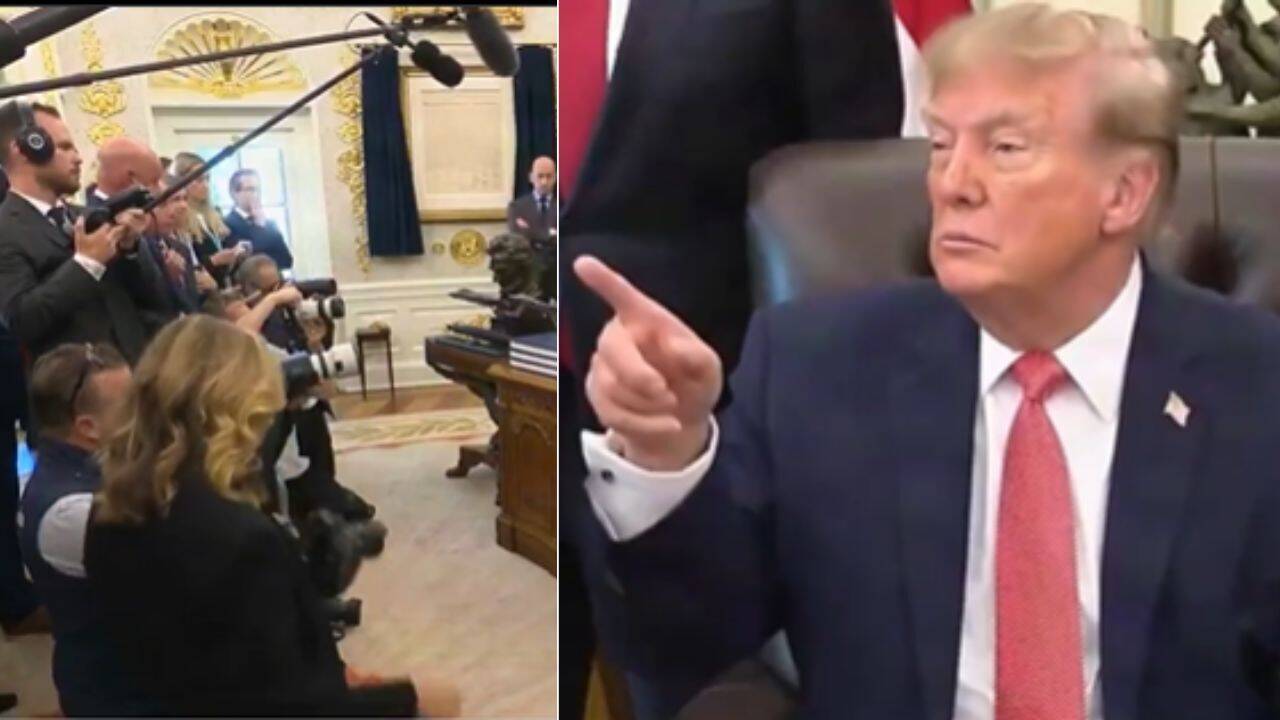
Photo via The Independent

Trump lost control and ordered me to be ‘quiet’ in the Oval Office. Then it got personal

Read the original at The Independent ↗
Cite

Feinberg, A. (2026, October 24). Trump lost control and ordered me to be ‘quiet’ in the Oval Office. Then it got personal. The Independent. https://www.independent.co.uk/news/world/americas/us-politics/trump-reporter-oval-office-andrew-feinberg-b3072685.html

Dated from the outlet's own feed. Check the original for its byline.

The Independent · collected 2026-10-24 · by Andrew Feinberg

Quick Summary

A reporter recounts an incident during a White House event where President Donald Trump became upset after being questioned about a whistleblower reward program. The reporter, part of the secondary print pool for that day, noted that Trump’s program was less generous than existing federal laws and pointed out historical inaccuracies in Trump's claims. As a result of asking questions, the reporter faced verbal attacks from both Trump and Vice President JD Vance, with officials using derogatory terms to describe the journalist. The article focuses on the confrontation between the press and the administration over factual inaccuracies and attempts by the White House to marginalize critical reporting.
Written by AI on 2026-10-24, from this article's own text only (the story summary below draws on all the coverage).
See how they differ ↓

AI analysis

Story summary

On October 21, 2026, US President Donald Trump confronted Independent reporter Andrew Feinberg in the Oval Office during a press event about a new whistleblower program offering rewards of up to $30,000. Feinberg questioned the rationale behind the proposal, noting that existing laws already allow whistleblowers to receive a share of recovered funds. In response, Trump angrily told Feinberg to be "quiet" multiple times and asked if he was "sick." Vice President JD Vance intervened by calling Feinberg's question "dishonest," while later sharing a clip of the exchange on X (formerly Twitter) to criticize Feinberg further.

The incident occurred as part of what the Trump administration calls the “secondary print” element of the White House press pool, where rotating news outlets are invited to cover events. This time, Feinberg's role was solely to ask questions during an event where Trump and Vance discussed a program aimed at uncovering alleged fraud through bounties for whistleblowers. Feinberg’s questioning also touched on changes to East Potomac Park, including the introduction of a new golf course, which prompted further interruptions from Trump.

Feinberg previously stated that he had prepared a list of questions with his colleagues but decided to adjust his approach when informed about the upcoming announcement by Trump and Vance. The False Claims Act, mentioned in Feinberg's account, has been in place since Abraham Lincoln’s presidency and allows for whistleblower rewards based on recovered funds.

Written for “Trump Orders Reporter To Be Quiet” on 2026-11-21, grounded in this article and the 2 other(s) covering the same event.

How they differ

2 outlets covered “Trump Orders Reporter To Be Quiet”.

What each outlet says

One AI summary per outlet of its latest article on this story, written from that article alone and checked against it. Open the article for the outlet's own words.

The IndependentThis outlet24 Oct

A reporter recounts an incident during a White House event where President Donald Trump became upset after being questioned about a whistleblower reward program. The reporter, part of the secondary print pool for that day, noted that Trump’s program was less generous than existing federal laws and pointed out historical inaccuracies in Trump's claims. As a result of asking questions, the reporter faced verbal…

Trump lost control and ordered me to be ‘quiet’ in the Oval Office. Then it got personal (this article)2 articles from The Independent on this story
Times of India21 Oct

During a White House event on Tuesday, US President Donald Trump interrupted and verbally confronted Independent reporter Andrew Feinberg for questioning a new whistleblower program. Trump told Feinberg to be “quiet” multiple times and asked if he was “a sick person.” The incident occurred as Trump and Vice President JD Vance were discussing the initiative, which offers up to $30,000 rewards for reporting fraud…

'Quiet, quiet, are you a sick person?' Trumps snaps at reporter at White House; watch →

Compared with similar articles

This article reads leans strongly left and hedges 24% of its claims. Each row says how that neighbour differs.
The Independent
Leans left further right than this Hedges 9 of 33 claims Outlet record 59/100
Times of India
Hedges 2 of 12 claims Outlet record 59/100

Story

Trump Orders Reporter To Be Quiet
Politics · 3 article(s) covering the same event. See how they differ ↑
How this article was measured signals, leaning charts, publisher record, byline, topics and claims

Signals How these are calculated →

Claims extracted
38
sentences that state something as happening or true
Uncertain
24%
9 of 38 hedged ("reportedly", "may", "according to")
Leaning
Leans strongly left
of the writing, not the subject · beta estimate
Publisher signals
59/100
The Independent's corrections and hedging, across everything collected from it. Not a measure of accuracy.
Outlets on this story
3
Politics
Same framing elsewhere
1
articles that frame the event the way this one does
Analyzed 2026-10-24 · how these are computed

How this is being covered How these are calculated →

Article leaning vs. publisher reliability
Source leaning vs. consistency

Publisher

The Independent · 4787 article(s) · 10 correction(s) detected
Running correction rate · 10 correction(s)

Who wrote this

Andrew Feinberg
54 article(s) here · 1 carrying a prediction
He did not elaborate on what would make any agreement “real” versus not.
Fox News correspondent Jacqui Heinrich, the current president of the White House Correspondents’ Association, pointed out on X that the pool’s phones were not taken when Trump left Beijing after his state visit in May.
Anyone with a passing knowledge of history and geopolitics would undoubtedly dismiss each of those fictional situations as ridiculous hypotheticals, as would the idea of any American president kowtowing to an authoritarian adversary.
2026-11-19 · assertive framing · Trump fanboyed over Putin, again. To what end?
The Chinese autocrat made a rare trip to the airport in Shenzhen, South China, to greet the American president when he landed on Air Force One for a series of meetings that will include a trilateral sit-down between Trump, Xi and Russia’s Vladimir Putin.
During a briefing ahead of Monday’s departure from Washington, White House assistant press secretary Olivia Wales told reporters that Trump would raise “the reduction of nuclear weapons in the world, whose proliferation President Trump believes is very dangerous.”
He said he hoped the assembled heads of state would be “working very hard on critical minerals, rare earths, and magnets,” referencing raw materials that are key ingredients in advanced electric motors and battery technology that are currently sourced mainly from China, providing Xi Jinping’s communist government with a key leverage point in Beijing’s trade relationships.
President Donald Trump said Monday that he would welcome the return of Jensen Huang as chief executive of Nvidia - days after the chipmaker's co-founder was forced out over an extramarital affair with a Chinese businesswoman - and insisted that no one had proven the woman was a spy.
The pair were reportedly working the phones to buttonhole a roster of show-business power players about the bill, even as airports nationwide descended into chaos, leading one of the people they called to reportedly ask Trump whether his focus might be better spent on the air-travel emergency.
House Democrats will take back the majority in January and have the power to impeach President Donald Trump for a third time.
Also by Andrew Feinberg
Nothing else under this byline is closely related to this article, so these are simply their most recent.
All 54 articles by Andrew Feinberg →

Topics

Independent Minnesota New York White House the False Claims Act

Subjects

Trump PERSON · 13× Vance PERSON · 3× White House ORG · 3× Abraham Lincoln PERSON · 2× Shirley PERSON · 2× Independent ORG · 1× Minnesota GPE · 1× New York GPE · 1× Nick Shirley PERSON · 1× a Mongoloid Moron PERSON · 1×

Narrative

I had a list that I discussed with my colleagues in New York, but I decided to call an audible when a reporter posted that Trump and Vice President JD Vance planned to unveil a new program and “tip line” to award so-called “whistleblowers” bounties of up to $30,000 for exposing what the administration believes to be “fraud.”
framing: mixed · carried by 1 article(s) · first seen 2026-10-24
Who could have guessed that Trump would get so spun up over a law that’s been on the books since Abraham Lincoln was president?

Claims (38 extracted, 9 hedged)

Who could have guessed that Trump would get so spun up over a law that’s been on the books since Abraham Lincoln was president? uncertain
Lincoln → guess → books
I certainly didn’t when I arrived at the White House this morning. asserted
I → arrive → House
I was there as part of what the Trump administration has dubbed the “secondary print” element of the White House press pool, part of the rotating group of news outlets that it brings into the Oval Office for events. asserted
it → dub → events
Normally, I am the designated “print pool” reporter approximately once a month, where I file short reports detailing what goes on in the Oval Office or any other event the president attends. asserted
president → designate → Office
This time, my only function was to ask questions. asserted
function → ask → questions
I had a list that I discussed with my colleagues in New York, but I decided to call an audible when a reporter posted that Trump and Vice President JD Vance planned to unveil a new program and “tip line” to award so-called “whistleblowers” bounties of up to $30,000 for exposing what the administration believes to be “fraud.” asserted
administration → have → 30,000
Then I became the focus of Trump’s attacks. asserted
I → become → attacks
For doing my job, I became the target of Trump and his team. asserted
I → do → Trump
Soon after, Trump lectured and unleashed at me his White House rapid response, who called me a “Mongoloid Moron” – which is a slur for someone with development disabilities, a phrase I would never use – and the Vice President on his official government account labeled me an ‘imbecile.’ asserted
President → lecture → me
All for an event that started off pretty normal. asserted
that → start → event
White House officials were going to hand out a reward to Nick Shirley, the right-wing YouTuber whose viral videos jump-started the administration’s crusade against day-care and home health care businesses in Minnesota run or owned by Somali-Americans. asserted
videos → go → Americans
For their part, Trump, Vance and even Shirley acted like the idea of rewarding whistleblowers was new and unique to this administration, with the YouTube personality claiming there has “never been an incentive for anyone to ever expose fraud” in the country’s entire history. asserted
anyone → act → history
Because I’ve spent most of my professional life covering the federal government, I know there’s already a mechanism to reward whistleblowers on the books, I knew Shirley — and the rest — were dead wrong about that. asserted
Shirley → spend → that
Since 1863, a law called the False Claims Act has allowed whistleblowers to sue on behalf of the federal government to recover funds that have been defrauded from federal programs. uncertain
that → call → programs
That law pays people more than Trump suggested through his program. uncertain
Trump → pay → program
These lawsuits, called qui tam cases, often involve the exact types of Medicare and Medicaid fraud on which the administration claims to be cracking down. uncertain
administration → call → which
And unlike the relatively paltry 1 percent which Trump claimed whistleblowers can be awarded, the False Claims Act allows someone who blows the whistle and brings a qui tam case to receive as much as a quarter of whatever the government recovers. uncertain
government → claim → whatever
The process is complex, onerous, and requires legal assistance, but the payout at the end can be significant. asserted
payout → require → end
The new program Trump and Vance were touting appeared far less lucrative — and left Trump, not a federal judge, as the arbiter of who would be worthy of any rewards. asserted
who → tout → rewards
So why would anyone use the administration’s “tip line” when they could get far more cash for using the tried-and-true process that’s been around since the days of Abraham Lincoln? uncertain
that → use → Lincoln
I asked the president that exact question. asserted
I → ask → question
“Because it’s a lot of money. asserted
it → ’ → money
“At 1 percent, people will make millions and millions of dollars for turning in what actually is a somewhat routine crime of, you know, of millions of millions. asserted
you → make → millions
But we’re talking about we’re talking about billions and actually probably trillions of dollars,” said Trump, who may not have understood the question or was unable to fathom that ten to 25 percent is far more than one percent. uncertain
percent → talk → question
Trump may not have understood the query, but Vance did — and he was eager to mix it up. uncertain
he → understand → it
Months earlier, we tangled in the briefing room when I asked him about the president’s stock trading. asserted
I → tangle → trading
And it appeared that the Veep was unsatisfied with Trump’s response, so he chimed in to call the question “dishonest” and suggest there are certain frauds that fall outside the False Claims Act’s remit, which is not true. uncertain
which → appear → remit
Sensing that he had been emasculated by the VP, Trump asked me who I was, which was odd because he had definitely recognized me earlier when he winked at me as Vance delivered remarks earlier in the event. asserted
Vance → sense → event
I’ve been around him in the Oval, aboard Air Force One and elsewhere countless times over the decade I’ve covered him, and we’ve even spoken on the phone on a number of occasions. asserted
we → cover → occasions
But Vance’s interjection compelled Trump to ask: “Who are you?” asserted
you → compel → Trump
I answered him and said I’m Andrew Feinberg and I work for The Independent. asserted
I → answer → Independent
As the press gaggle went on, I attempted to ask more questions from the list I’d prepared — including one on his plans to renovate a popular D.C. golf course. asserted
I → go → course
Trump appeared to point to me more than once, but on each occasion he had apparently intended to call on the Agence France-Presse reporter directly behind me. asserted
he → appear → me
Because from my vantage point he was pointing directly at my face, I started to speak up. asserted
I → point → face
He didn’t like that. asserted
He → like → that
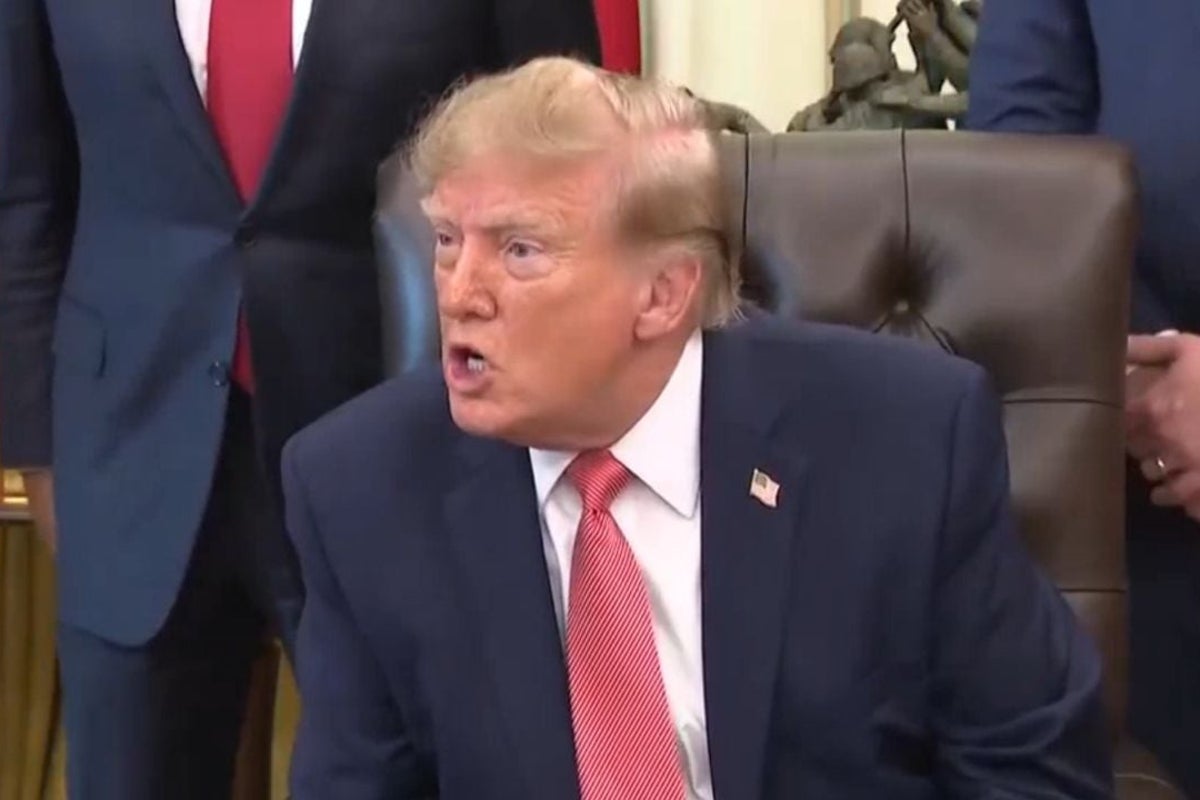
“I don’t know who the hell you are, but you better be careful,” he said, an odd remark considering I’d identified myself not 10 minutes earlier. asserted
I → know → myself
When the same thing happened minutes later, he lost it completely, calling me a “sick person.” He added: “I actually think there’s something wrong with you.” For the record, I had an annual physical earlier this month, and I can report I’m in perfect health. asserted
I → happen → health
I was doing my job, and I’ll be right back at it tomorrow. asserted
I → do → it
Give feedback · no sign-in needed

No sign-in needed for now. Your note is sent without a name, so it cannot be answered.

History Support