Photo via The Straits Times

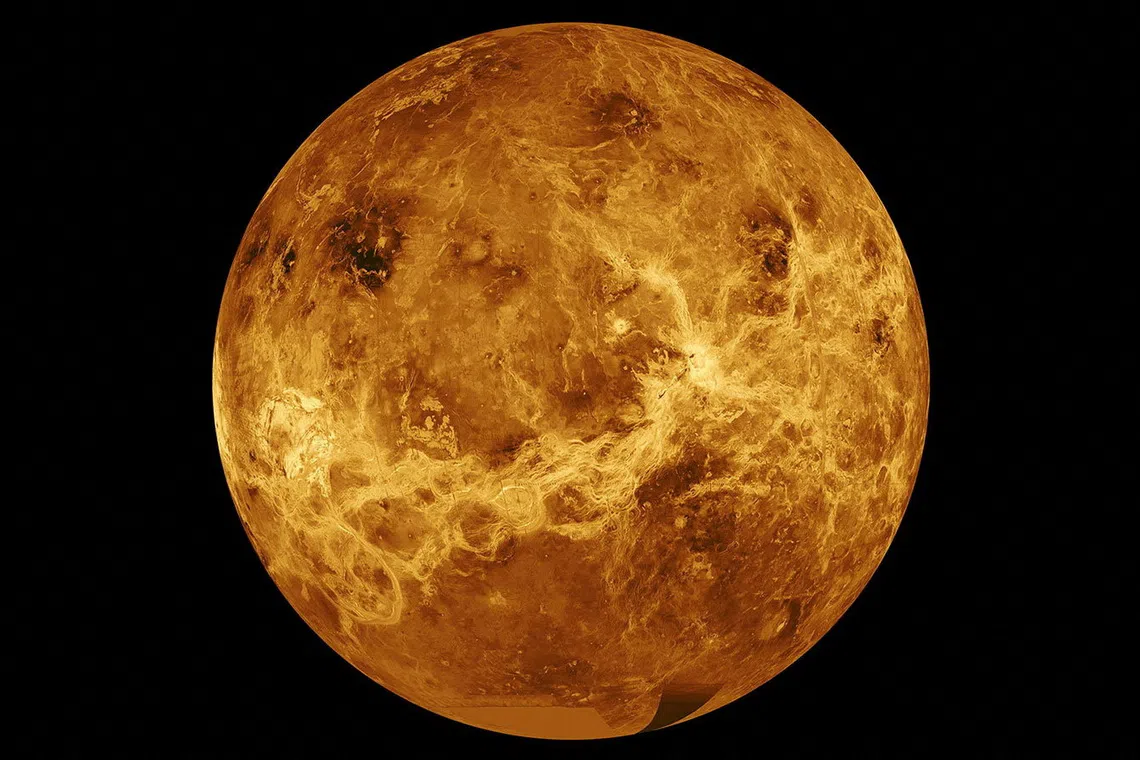
Astrophysics study suggests Venus may have swallowed its moon

Read the original at The Straits Times ↗
Cite

The Straits Times. (2026, September 15). Astrophysics study suggests Venus may have swallowed its moon. The Straits Times. https://www.straitstimes.com/world/united-states/astrophysics-study-suggests-venus-may-have-swallowed-its-moon

Dated when The Aporia collected the article, usually within hours of publication. Check the original for its exact date and byline.

The Straits Times · collected 2026-09-15 · by The Straits Times

Quick Summary

A study published on September 14 by astrophysicists at the University of California, Riverside, suggests that Venus may have once had a moon that eventually crashed into the planet due to its extremely slow rotation speed. Stephen Kane, the lead author, argues this theory based on computer models showing hypothetical moons spiraling inward and colliding with Venus within about a billion years after the planet's formation. This contrasts with previous theories proposing either the absence of lunar formation or destruction by an impact event.
Written by AI on 2026-09-15, from this article's own text only (the story summary below draws on all the coverage).
See how they differ ↓

AI analysis

Story summary

On September 14, an astrophysicist named Stephen Krane at the University of California, Riverside, proposed a new theory in The Astrophysical Journal explaining why Venus lacks a moon. According to Krane's research based on computer models simulating planetary physics and gravitational mechanics, any natural satellite orbiting Venus would have spiraled inward due to the planet’s extremely slow rotation speed and eventually crashed into it. This celestial cannibalism scenario suggests that if Venus once had a moon, it likely consumed it within a relatively short time frame. The study marks a significant shift from previous theories attempting to explain Venus's lack of lunar companionship.

Written for “Venus Swallowed Moon” on 2026-11-22, grounded in this article and the 1 other(s) covering the same event.

How they differ

2 outlets covered “Venus Swallowed Moon”.

What each outlet says

One AI summary per outlet of its latest article on this story, written from that article alone and checked against it. Open the article for the outlet's own words.

The Straits TimesThis outlet15 Sep

A study published on September 14 by astrophysicists at the University of California, Riverside, suggests that Venus may have once had a moon that eventually crashed into the planet due to its extremely slow rotation speed. Stephen Kane, the lead author, argues this theory based on computer models showing hypothetical moons spiraling inward and colliding with Venus within about a billion years after the planet's…

Astrophysics study suggests Venus may have swallowed its moon (this article)
New York Post18 Sep

A study by astrophysicists at the University of California, Riverside suggests that Venus may have once had a moon that was eventually pulled into the planet due to its extremely slow rotational speed. Published in The Astrophysical Journal, the research proposes that Venus’s rotation, taking 243 Earth days per cycle, would cause any natural satellite to spiral inward and collide with the planet within about one…

Astrophysics study suggests Venus may have swallowed its moon →

Compared with similar articles

This article reads unscored and hedges 29% of its claims. Each row says how that neighbour differs.
New York Post
Hedges 4 of 17 claims Outlet record 66/100

Story

Venus Swallowed Moon
Science · 2 article(s) covering the same event. See how they differ ↑
How this article was measured signals, leaning charts, publisher record, byline, topics and claims

Signals How these are calculated →

Claims extracted
17
sentences that state something as happening or true
Uncertain
29%
5 of 17 hedged ("reportedly", "may", "according to")
Leaning
not political
takes no side on a contested political question
Publisher signals
64/100
The Straits Times's corrections and hedging, across everything collected from it. Not a measure of accuracy.
Outlets on this story
2
Science
Same framing elsewhere
1
articles that frame the event the way this one does
Analyzed 2026-09-15 · how these are computed

How this is being covered How these are calculated →

Article leaning vs. publisher reliability
Source leaning vs. consistency

Publisher

The Straits Times · 5699 article(s) · 7 correction(s) detected
Running correction rate · 7 correction(s)

Who wrote this

The Straits Times
4005 article(s) here · 1 carrying a prediction
Annual inflation hit 11% in October and prices are expected to rise further this year, economists say, leaving many Ukrainians feeling the pinch and less able to spend on eating out.
While no one obtained everything they might have desired, everyone can find a place for themselves within this text—that is the very essence of consensus.
At least 14 people missing after Russian drone hit building in Kyiv region, Zelenskiy says KYIV, Nov 22 - At least 14 people may still be trapped under the rubble of a residential building that was struck by a Russian drone on Sunday morning in Ukraine's Kyiv region, President Volodymyr Zelenskiy said.
Ferguson said at a news conference that the ICE agents may have broken a state law limiting facial coverings for law enforcement, and that he was looking into how they accessed the jet bridge.
Before departing for his overseas trip, Trump told reporters that he might meet Kim in China.
The latest draft expressed “deep concern” that global warming would cross 1.5 deg C above pre-industrial levels in the next few years.
2026-11-22 · assertive framing · Fossil fuels still missing from latest COP31 draft deal
Mejia had also overstayed her visa, ICE said, adding that she would be charged with assaulting a federal officer.
She will be charged with assaulting a federal officer, according to ICE.
TEHRAN - Iran will impose rolling power cuts from Nov 22 as damage to key infrastructure during the Middle East war deepens an already severe energy crunch, state media reported.
2026-11-22 · assertive framing · Iran to ration electricity as war hits energy network
Party strategists anticipate that the field of 2028 aspirants could be far wider than what was expected at the start of the administration, when Trump joked about seeking a constitutionally-barred third term.
Also by The Straits Times
Nothing else under this byline is closely related to this article, so these are simply their most recent.
All 4005 articles by The Straits Times →

Topics

California LOS ANGELES The Astrophysical Journal Venusian the University of California, Riverside

Subjects

Krane PERSON · 4× Reuters ORG · 2× Venusian NORP · 2× California GPE · 1× LOS ANGELES GPE · 1× NASA ORG · 1× Stephen Krane PERSON · 1× The Astrophysical Journal ORG · 1× UC Riverside ORG · 1× the University of California, Riverside ORG · 1×

Narrative

Krane said data from computer models based on planetary physics and simulating the gravitational mechanics of hypothetical Venusian moons of various sizes showed them all meeting the same fate – sooner or later collapsing into their mother planet.
framing: mixed · carried by 1 article(s) · first seen 2026-09-15
Astrophysics study suggests Venus may have swallowed its moon AI generated
2026-09-15 · The Straits Times
Astrophysics study suggests Venus may have swallowed its moon · mixed framing

Claims (17 extracted, 5 hedged)

Astrophysics study suggests Venus may have swallowed its moon AI generated uncertain
Venus → suggest → moon
A California-based astrophysicist presented a new theory on Sept 14 to explain why Venus, the planet most like Earth in size, mass and structure, lacks its own moon. asserted
Venus → base → moon
The extremely slow speed at which Venus rotates on its axis would have doomed any natural satellite that may once have orbited that planet to gradually spiral closer to its parent and ultimately be consumed in a cataclysmic smash-up. uncertain
that → rotate → up
So goes the theory offered by scientists at the University of California, Riverside, and published on Sept 14 in The Astrophysical Journal, marking a departure from past explanations for why Venus, the second planet from the sun, is without a lunar companion. “If it had a moon, and it likely did at some point, it could not have kept it,” astrophysicist Stephen Krane, lead author of the study, told Reuters. uncertain
Krane → go → Reuters
“That moon would have crashed down on the planet in a relatively short time scale. asserted
moon → crash → scale
Krane said data from computer models based on planetary physics and simulating the gravitational mechanics of hypothetical Venusian moons of various sizes showed them all meeting the same fate – sooner or later collapsing into their mother planet. asserted
them → say → planet
Such a presumed moon-gobbling event likely occurred within the first billion years in the history of Venus, which like the rest of the solar system dates back about 4.5 billion years, Krane said. asserted
Krane → presume → system
Scientists previously theorised that Venus, known as Earth’s “twin”, either never acquired its own moon to begin with, or possibly had a moon that was obliterated in the massive impact from another celestial object. uncertain
that → theorise → object
Earth spins more swiftly than Venus asserted
Earth → spin → Venus
The UC Riverside study, focusing on Earth-moon dynamics, found that planetary rotational speed was the key factor. asserted
speed → focus → dynamics
In contrast to Venus, which takes 243 Earth days to complete a single rotation – slightly longer than its orbit around the sun – Earth spins on its axis every 24 hours, more than two hundred times more rapidly than Venus, Krane said. asserted
Krane → take → Venus
The transfer of energy from Earth’s faster rotation is gradually pushing our moon farther away, causing it to recede from Earth at the rate of 4cm a year – precisely measured by mirrors left on the lunar surface in 1969 by Apollo 11‘s astronauts. asserted
it → push → astronauts
Venus, the third brightest object in the night sky after the sun and moon, looms large as point of study for scientists seeking to learn more about Earth’s history, and its future. asserted
Venus → loom → history
Similar in its rocky structure but slightly smaller than Earth, Venus is enveloped in a thick, toxic atmosphere that has created a runaway greenhouse effect, scorching its surface at temperatures as high as 471 deg C, hot enough to melt lead. asserted
that → envelop → lead
While there is no proof a Venusian moon ever existed, it is unlikely that Venus, in its infancy, somehow avoided the kind of world-shattering collision with another proto-planet that is widely believed to have formed Earth’s moon, according to Krane. uncertain
that → be → Krane
The dawn of the inner solar system was crowded with large rocky objects hurtling through space and smashing into one another, with Venus probably taking more celestial hits than Earth because Venus was closer to the sun. asserted
Venus → crowd → sun
Scientists hope to unlock more secrets of Venus with two forthcoming NASA missions set for launch in the late 2020s or early 2030 dubbed DAVINCI+ and VERITAS to study the planet’s atmosphere and geologic features. asserted
Scientists → hope → atmosphere
Give feedback · no sign-in needed

No sign-in needed for now. Your note is sent without a name, so it cannot be answered.

History Support